Sunday, December 31, 2023

It’s a boy for the count and countess of Paris


Both photos courtesy of HRH the Count of Paris 


The couple’s 6th child was born earlier today.  The newest Prince is named Alphonse Charles Francois Marie.  Thank you very much


Saturday, December 30, 2023

Breaking news: Michael abdicates, People's Republic established

Embed from Getty Images 

December 30, 1947

News organizations, including the New York Times and the Associated Press, are reporting that King Michael of Romania abdicated earlier today and the "Communist-dominated Government immediately proclaimed a 'People's Republic.'"

King Michael, 26, is the last surviving monarch behind the Iron Kingdom.  He apparently made the decision to abdicate "suddenly," and his decision was "announced by radio to the Romanian people without warning" at 6 p.m.

His reason for abdicating was not made public.

The king returned to Romania nine days ago from his "first trip abroad since the war."  He returned to the country "determined" to fight for his throne and to obtain the Communists' permission to marry Princess Anne of Bourbon-Parma, whom he met while he was in London to attend Princess Elizabeth's wedding.

The Associated Press is reporting that a Government official told their reporter that the King was "free to live in Romania and marry Princess Anne."

The Communist takeover of Eastern European countries is now complete.  Poland, Czechoslovakia, Hungary, Albania, Bulgaria, and Romania are now completely under the influence of Communist governments "subservient to the Soviet Union."

King Michael was "undoubtedly loved by his people," but there have not been any "publicly known demonstrations against his removal."  Government radio has reported demonstrations in favor of the new government.

The King's abdication decree stated that "because of the great political, economic and social changes effected in Romania since the war, the monarchy no longer corresponded to the present conditions of a state and thus represented a serious obstacle to the country's future development," reported the New York Times.

The Groza Government immediately proclaimed a "people's republic."  The removal of the monarchy "opened great opportunities for the advancement of popular democracy and for increasing the welfare of workers, peasants, and intellectuals."

The King's decision "obviously came with great speed."  Members of his Court had no idea of what was happening and believed that the King would, "as usual receive all members of the foreign diplomatic corps on New Year's Day.

It is not known whether Michael will leave Romania or not.  News organizations have not been able to "establish contact with members of his staff by telephone or in person."

Michael's father, former King Carol II, who lives in Estoril, Portugal, received the news of his son's excitement with "apparent satisfaction and excitement."  But he refused to make any comment when he was interviewed by a reporter.

"I have always refused to make statements to the press until now as I did not want to embarrass in any way the course of events in Romania.  In view of the latest events, I feel I shall soon be able to speak freely, but this I shall do only after my son is safely out of Romania."

King Michael succeeded his father in 1940.


Embed from Getty Images 
 Princess Anne of Bourbon-Parma, who is believed to be engaged to King  Michael, told reporters she has not heard from him.  She would not comment on "the news of the abdication.

 The Princess is staying with relatives in Copenhagen.    Her mother, Princess Margarethe, was born a Princess of Denmark.


Mail Call


This is the front of the thank you card from  Baron Victor von Baillou's widow, Archduchess Alexandra of Austria.  The inside included a private message to me.


@Royal Palace, Belgium

Friday, December 29, 2023

A Christmas Engagement: Oldenburg-Moy de Sons

 On Christmas Day,  HH Duchess Katharina of Oldenburg said yes to Count Clemens Moy de Sons's marriage proposal.

Duchess Katharina Bibiane Edwina Isabell is the fourth and youngest child of Duke Christian of Oldenburg and his wife, Countess Caroline zu Rantzau.  She was born in Lübeck on February 20, 1997.

Count Clemens Ernst Johannes Maria is the youngest of four children and the only son of Count Guy Maria Hubertus Ulrich Konrad Moy de Sans and his wife Verena von Stein zu Lausnitz.  He was born in Munich on December 22, 1985. 

  Embed from Getty Images


The duchess will receive a BA in Media and Communication Management in January from the Macromedia University in Applied Sciences in Munich, Germany.   

Count Clemens grew up in Schloss Stepperg, the family's ancestral home in Neuburg-Schrobenhausen, Bavaria.  Through his father, Count Clemens is a descendant of HSH Princess Sophie Friederike Caroline Luise of Saxe-Coburg-Saafeld, Duchess of Saxony (1778-1835) and Count Emmanuel von Mensdorff-Pouilly (1777-1852).    Sophie was the sister of  Ernst I, Duke of Saxe-Coburg and Gotha, King Leopold I of the Belgians, and Victoria, Duchess of Kent.  She was the aunt of Queen Victoria and Prince Albert.  

https://www.donaukurier.de/archiv/schatzsuche-im-landkreis-3742573

Wednesday, December 27, 2023

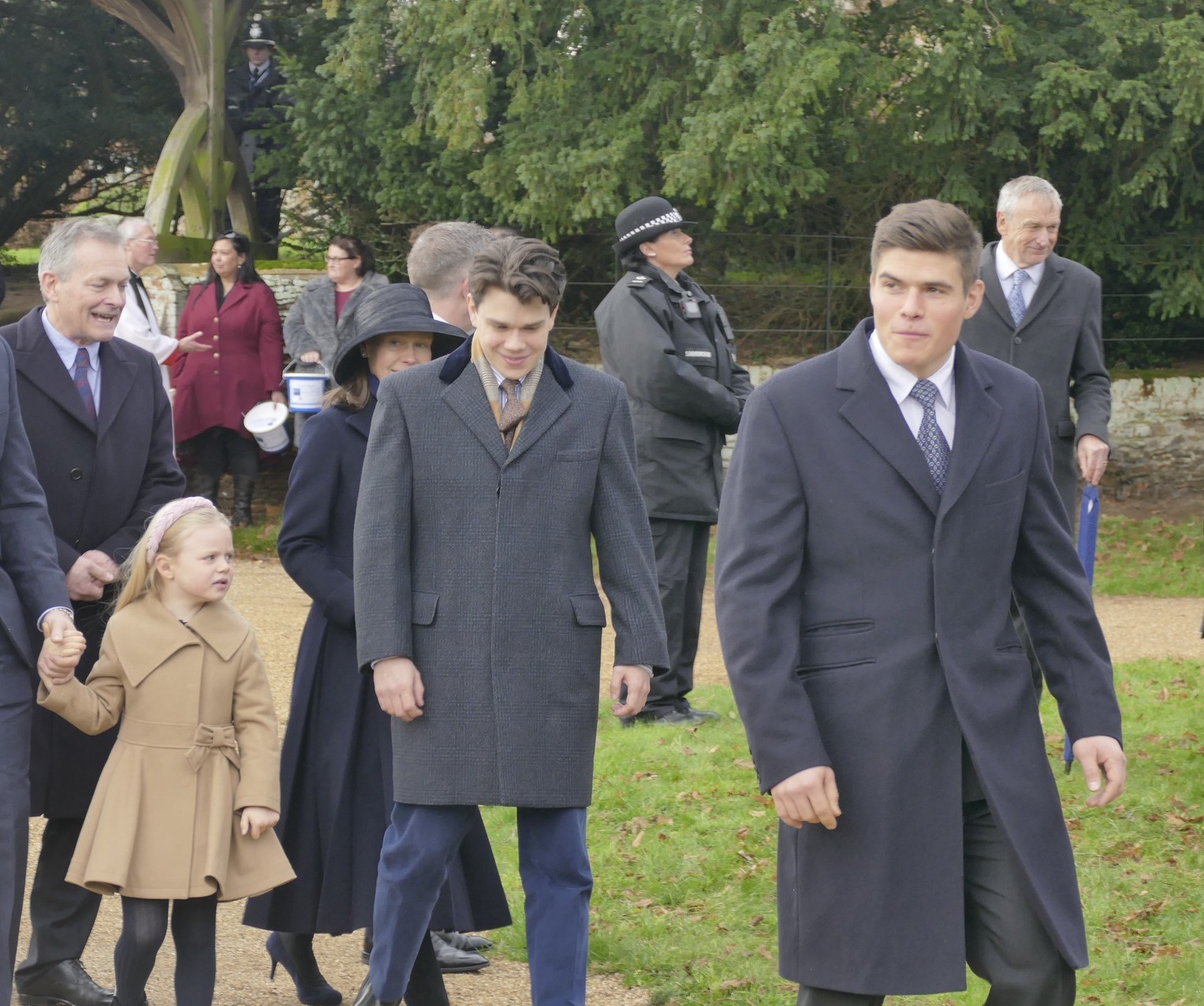
Christmas at Sandringham


5
all the photos are the copyright of Ken Stone
Ken Stone and his lucky camera were at Sandringham on Christmas morning. Thank you, Ken, for allowing me to use your photos!!

Sunday, December 24, 2023

Hanover brides and the Queen Charlotte's bridal crown


In 1761, King George III gave his bride, Duchess Charlotte of Mecklenburg-Strelitz, a nuptial crown that she wore on her wedding day and for her Coronation.    She wore the nuptial crown on numerous occasions. She lent the crown to Princess Caroline of Brunswick when she married the Prince of Wales. Queen Charlotte died in 1818, and she bequeathed her jewels "to the House of Hanover, or to be settled upon it, and considered as an Heir Loom, in the direct Line of Succession of that House."  Charlotte died one year after her granddaughter, Princess Charlotte of Wales

Princess Charlotte was the only child of the Prince Regent. In November 1817, she died after giving birth to a stillborn son.   The Queen would have been aware of the two kingdoms separating if Princess Charlotte had not died in childbirth. She would have succeeded her father in 1830, and the Duke of Clarence would have become the King of Hanover.  

The battle of the jewels began after Victoria succeeded to the throne in 1837 and her uncle, Prince Ernest Augustus, Duke of Cumberland, inherited the Hanoverian throne. This was due to the Salic law (which applied to males only). He was styled as King  Ernst August I. 

 But it was not until December 1857, seven years after his death, that a British commission ruled in Hanover's favor.    It was "difficult to identify" which jewels the late King and his son, King Georg V, were claiming. According to the late biographer, Cecil Woodham-Smith, "certain jewels worth £50,000 in 1761, a great sum at that time, had been bought by George III to be presented to Queen Charlotte."   These jewels, which included the nuptial crown, were bought "with English money," and it was ridiculous to call them the "Hanoverian Crown jewels." 

It was suggested that King Georg V hoped for a financial settlement rather than the return of the jewels. This did not happen. Hannover's ambassador, Count Adolphus von Kielmansegg, was tasked with bringing the jewels to Hanover.

Queen Victoria, however, had the last laugh. In 1867,  King Georg V of Hanover (who was Victoria's first cousin) sided with Austria in its war with Prussia. This was not a smart move, as Prussia was more powerful than Austria. Prussia exacted its revenge on Hanover by annexing the country. King Georg and the royal family went into exile to their home in Gmunden, Austria.

The jewels were buried for safekeeping until arrangements could be made to remove them from Hannover. At some point, the jewels were taken to Austria, and in 1870, they were returned to England.

 It was the former ambassador's wife, Countess  Juliane (nee von Zesterfleth), who undertook the assignment to bring the jewels back to England. The jewels were sewn into her clothes, and she wore the nuptial crown under her hat. Countess Juliane, then 62 years old, left Vienna for London. This "courageous, wonderful old lady travelled all the way to Vienna with this heavy ponderous piece of jewellery on her head," to Calais, France, when she met Grand Duchess Augusta of Mecklenburg-Strelitz, who was a British and Hanoverian princess by birth, and the sister of the Duchess of Teck (Princess Marie Adelaide of Cambridge.)

In 1948,  the Grand Duchess's niece, Queen Mary, read the story about the jewels being brought back to England. She wrote a note, which is in the Royal Archives: "After reading the enclosed story about the saving of the Hanoverian Crown Jewels in 1866, I remembered that my Aunt the Grand Duchess of Mecklenburg-Strelitz had told me that when she was coming to England on a visit in 1870 when she arrived at Calais to embark in her special steamer (in those days every member of the royal family was given a special steamer for crossing the Channel), a Hanoverian lady she knew met her and asked whether the Grand Duchess would give her a passage to England because she had the Hanoverian crown jewels sewn into her dress and that the crown was inside her hat, she was to deposit them in the Bank of England in London for safekeeping. Of course, the Grand Duchess consented readily. This lady must have been the Countess Kielmansegge mentioned in the story."

Some sources state that the jewels eventually were returned to the Hanovers, but this is incorrect. The jewels, including the Nuptial crown, are kept at Windsor. Hanover has not existed as an independent kingdom since 1866. In November 1918, Kaiser Wilhelm II and the other German Sovereigns abdicated their positions and the German Republic was established.

The de jure King of Hanover,  Prince Ernest August, Duke of Cumberland, was one of three British peers who were stripped of their British titles in the 1917 Titles Deprivation Act.   His son, Prince Ernst August, Duke of Brunswick, was married to Kaiser Wilhelm II's only daughter, Princess Victoria Luise.


Since 1900, the bridal crown has been lent by the British sovereign to several Hanover brides. There is no evidence that Princess Frederica of Hanover, who married Baron Alfons von Pawel-Rammingen, wore the crown at her wedding in the Private Chapel at Windsor in 1880.  

There are no photos of the wedding of the next Hanover bride, Princess Marie Louise, the eldest daughter of the Duke and Duchess of Cumberland. The Duchess of Cumberland was born Princess Thyra of Denmark, the younger sister of Queen Alexandra.

An extensive report of the wedding was published in the Wiener Salonblatt in July 1900. This is a rough translation of the description of the bride's headpiece. "A wreath made from myrtles and orange blossoms was on top of her hair with a ducal crown surmounted by diamonds..."


The next to wear the crown was Marie Louise's sister, Princess Alexandra.   On both occasions, the crown was lent to the Princesses by Edward VII. He was their uncle by marriage as their mother and Queen Alexandra were sisters.


Grand Duke Friedrich Franz IV of Mecklenburg-Schwerin and Princess Alexandra of Cumberland,  June 7, 1904


Princess Victoria Luise of Prussia, the only daughter of Kaiser Wilhelm II, married Prince Ernst August of Hanover on May 26, 1913. This was the last major royal wedding before the outbreak of World War I.

There are no photographs from this wedding. There are numerous sketches of the wedding and the Torch Dance.

This is not a wedding photo.   Let's call it primitive Photoshop.

  The veil and the Brunswick tiara were added to the postcard after the wedding. The original postcard was published at the time of the engagement. I have several royal postcards in my collection of fake wedding photos with the veils added.
This is the real image.   

Princess Victoria Luise confirmed in her autobiography that she wore the bridal crown for princesses of Prussia.   This is a sketch of the Fackeltanz.

This sketch also shows the princess wearing a small crown.


Princess Friederike of Hanover married Prince Paul of Greece on January 9, 1938
King George VI sent the Crown to Athens for this wedding.

Princess Ortrud of Schleswig-Holstein married Prince Ernst August of Hanover on September 5, 1951


The crown was "lent by King George," according to The Times (September 5, 1951). This was also reported in the German press.

Princess Alexandra of Ysenburg und Büdingen married Prince Welf-Heinrich of Hanover on September 21, 1960


Two days before Prince Welf-Heinrich's wedding, The Times (September 20, 1960published a three-paragraph story:  The Queen Lends Diamond Crown.   "A Buckingham Palace spokesman said last night that the crown is a decorative piece, not a crown of State but it is part of the Hanover jewelry.
 "The crown, which is studded with diamonds, is about the size of a large apple and sits on the back of the head. It belonged to the Hanoverian monarchs and went to Hanover when Victoria came to the throne. Somehow it found its way back to England and has been in the collection at Windsor for many years."

The bridal crown was flown to Frankfurt before the wedding.

Prince Christian of Hanover married Mireille Dutry on November 25, 1963. This marriage was morganatic.   Queen Elizabeth was not asked to lend the crown for this wedding.

The marriage between Prince Andreas of Leiningen (now the Prince of Leiningen) and Princess Alexandra of Hanover on October 11, 1981

Alexandra and Andreas

Princess Alexandra of Hanover is the most recent bride to wear the crown. At the time of the wedding, the local press reported that Queen Elizabeth II had lent the crown to Princess Alexandra. After the wedding, the crown was returned to the Queen.

The crown was not worn by Chantal Hochuli when she married Prince Ernst August of Hanover, the present head of the house, in 1981, nor by her two daughters-in-law, Ekaterina Igorievna Malysheva and Alessandra de Osma, when they married Prince Ernst August and Prince Christian, respectively.

 The "antient (ancient) Hanoverian jewels" consisted of Queen Caroline's "pearl earrings and drops" as well as "the stones which had adorned her stomacher."  This latter piece of jewelry had been reset "in the bodice ornament" made for Queen Charlotte in 1761.

King Georg V of Hanover was also awarded Queen Charlotte's diamond bows, three-drop, and single-drop earrings, necklace pendant cross, nuptial crown, a nosegay" and the original stones from Queen Caroline's stomacher. The stones from three of Queen Adelaide's "diamond wheatear ornaments" were also sent to Hanover. Count Adolphus von Kielmansegge took back to Hanover two small pearl necklaces, as King Georg agreed Victoria could have the two large pearl necklaces.

After Prussia annexed Hanover in 1866, the kingdom ceased to exist, and the family went into exile. Most of their wealth was taken by von Bismarck. It took some years to negotiate a settlement. It made more sense to bring the jewels back to England.   It is wrong to call these jewels "Crown Jewels" because Hanover did not become a kingdom until 1814. Most of the jewels were used by several female members of the family, and it was Queen Charlotte who left some of her jewels to the House of Hanover. None were Crown Jewels.

Victoria's uncle, King Ernst August, based his claim as the male heir to the Hanover line.   

If you liked this post, you could buy me a cup of coffee.