Friday, May 23, 2025

Lady Nicholas Windsor spotted at Rome event


Ira Mira, Princess Gesene Doria Pamphilj & her husband, Massimiliano Floridi, and Lady Nicholas Windsor at Palazzo Doria Pamphilj in Rome  March 2025
@ira mira Instagram


Earlier tonight, a friend and I talked about different members of the Royal Family. He mentioned Lady Nicholas Windsor (Paola Frankopan) and said she had not attended royal events in the final years of Queen Elizabeth II's reign.    

  Embed from Getty Images 


 Lady Nicholas did not accompany her husband to Lady Gabriella Windsor's wedding in 2019 (Nicholas came with one of his sons), the Platinum Jubilee events in June 2022, or Queen Elizabeth's funeral in September 2022.

In the first few years of their marriage, they attended Ascot, the Trooping of the Colour, and other family events. In 2012, they attended Queen Elizabeth II's Diamond Jubilee Thanksgiving Service; four years later, they were among the guests at the Thanksgiving Service for the Queen's 90th birthday. Their last appearance was at the Trooping of the Colour was in 2017.

According to several sources, Lord Nicholas was a guest at King Charles III's Coronation, as he was included in the Court Circular and the official Coronation Roll.  

Court Circular May 6, 2023


His wife and the spouses of children and grandchildren of the Dukes of Gloucester and Kent, Prince Michael of Kent, and Princess Alexandra, the Hon. Lady Ogilvy, were not invited.

https://www.coronationroll.gov.uk/coronation_roll/the-processions/the-procession-of-the-royal-family-and-the-queens-family/

The following year, they were at Stephen Hawking's memorial service. 

 Lord Nicholas  Windsor, a godson of King Charles III, is the youngest of three children of Prince Edward, Duke of Kent, and Katharine Worsley.  


  Embed from Getty Images 


 He was born in July 1970 at King's College Hospital,  the first British royal born in a hospital.  In 1981, Nicholas was one of two pages at Charles's wedding to Lady Diana Spencer.

As a teenager, Lord Nicholas was a bit rebellious. When he was 18 years old, he was found in possession of a small amount of cannabis. He and his friend were taken to the Bow Street police station, where they were "let off with a caution."  A spokesman for the Duke of Kent released a statement to the press: "I can confirm that the facts are true and that Lord Nicholas was arrested for possessing drugs. He is staying with his family for the weekend.

It is not unusual for a person who is found with only a small amount of cannabis in their possession to be cautioned. This is the normal course of events."

A Scotland Yard spokeswoman denied that Lord Nicholas was "treated leniently simply because "he is a member of the Royal Family. Two years earlier, Lord Nicholas switched to Harrow for his A Levels after doing his O Levels at Westminster School. One family friend told the Daily Express: "Nicholas, being the youngest, is a bit spoilt. His mother absolutely dotes on him.  He's the sort of chap who might go around boasting, 'I'm Lord Nicholas,' and be bullied.  It wouldn't surprise me if that was why he asked to move."

He studied theology and philosophy at Manchester College, Oxford.   In September 1999, the Daily Mirror reported exclusively that Lord Nicholas had been "battling an eating disorder and depression" for six years and had been hospitalized several times.  Biographer Kenneth Rose, a family friend, said: "I understand he has had some sort of relapse, but he seems to be fighting it.  He's been suffering from eating disorders and depression for about six years now. I know his mother has a history of the two, maybe it's passed down."

At the time, Nicholas was living in a £250,000 townhouse in Pimlico and volunteering unpaid for charities in London and Oxford.   Three months later, he was in New York City, attending a New Year's Eve Party, where he met British-born Paola de Frankopan, a Roman Catholic with Croatian and Swedish ancestry.

 Nicholas, 54, converted to Roman Catholicism seven years after his mother became Catholic. The news broke on August 18, 2001, when he told the Times. "I can confirm that it is true, but I would prefer to say no more than that.  I consider the time and place to be a private matter."  It is understood that Lord Nicholas was received into the Catholic church on Easter Sunday in 2001.

Two years later, Nigel Dempster reported Nicholas was spotted canoodling in the stacks at the Chelsea Public Library.  "He was all over a beautiful young lady," described as an "elegant blonde."

  "They were reading magazines, but they couldn't keep their hands off each other.  Everyone could see them with their arms round each other," said one library patron.

Nicholas' cell phone rang, and he went outside to take the call, but he quickly returned, and the "cuddling continued."   The blonde was described as a "lovely Sloane-type, clad in a fluffy cream jumper, jeans and pointed black suede shoes."    Several hours later, Dempster confronted Lord Nicholas at his Pimlico home.   

"I'm sorry, I cannot talk about my private life," Lord Nicholas told the veteran society columnist, who noted in his article that Nicholas had a "long-time girlfriend called Paula, although she is a brunette."

Paula .... Paola... what is in a name?  Nigel Dempster might have been confused about Nicholas' girlfriend's hair color and name.

  His engagement to Paola de Doimi de Frankopan was announced in September 2006.  The couple had met five years earlier at a party in New York City.  Paola described their first meeting in an article she wrote in 2013 for Vogue.  "I met my future husband there [NYC] at a New Year's Eve party in 1999, in an apartment overlooking the Met, from which we could see the damp squibs of fireworks set off above a rainy Central Park....Both of us avoid New Year's Eve parties in general and had come reluctantly, but thank God we did! It was when Nicholas decided to call it quits before midnight -- on Millennium Eve -- that my interest was piqued by such independence of spirit, a quality I later learned is central to his character."

Paola Louise Marica Doimi de Lupis was born in London in August 1969, the daughter of Croatian-born Louis Doimi de Lupis and Ingrid Detter, a Swedish lawyer. Some years later, Louis adopted the title of Prince Louis Nicholas Anthony Doimi de Frankopan Subic, claiming to be of Croatian nobility. Croatian nobility experts have disputed this.

 She attended St. Paul's School and Wycombe Abbey before attending Gonville and Caius College, Cambridge, where she studied Classics. She also attended the Sorbonne, where she received a master's in philosophy.  

They were married in a civil ceremony on October 19, 2006, in London, as their wedding on November 4, 2006, at the Church of St Stephen of the Abyssinians in Vatican City was not a legal ceremony.    The night before their religious wedding, Nicholas and Paola hosted a dinner at the 15th-century Palazzo Taverno, once the home of the Borgia and Orsini families.   Their wedding reception was held at the 15th-century Palazzo Doria Pamphili, where one guest told Hello magazine: "the party dined by candlelight in magnificent state rooms surrounded by priceless works of art, enjoying Parma ham with mozzarella, grilled sliced beef and chocolate mousse."

The morning after the wedding,  Paola wrote in Vogue: "We had a brunch on a roof terrace—a setting haunted by stars of Cinecitta—with a breathtaking view of the Forum."

Her dress was from Valentino.  Paola "embraced the Roman patrician Catholic tradition that brides do not wear any jewelry on their wedding day: tiaras, no earrings, not even an engagement ring.  You are naked of these fineries as you go to your destiny.  I love the idea of such stark simplicity and surrender."

A source close to the newlyweds told Hello: "They are clearly very in love and they will take note of the fact that the Pope in his dedication dedicated them to the Virgin Mary, The Queen of the Family."

The couple has three sons: Albert Louis Philip Edward (2007), Leopold Ernest Augustus Guelph (2009), and Louis Arthur Nicholas Felix (2014). 


Embed from Getty Images  Embed from Getty ImagesEmbed from Getty ImagesEmbed from Getty Images 

 The three young men were baptized in the Roman Catholic faith.


  Embed from Getty Images 


 In the January 2011 issue of Tatler,  Paola wrote about her appreciation for late fashion designer Catherine Walker.. By 2010, the family lived in Italy  "in rural Umbria, as far from the maddening crowd as is possible and still be in Europe."   

Lord and Lady Nicholas returned to the United Kingdom for Pope Benedict XVI's visit in September 2010. They met him at Holyrood Palace and again in Birmingham.

That same year, Lord Nicholas claimed that "abortion was a bigger threat to Europe than al-Qaeda and Islamic terrorism."

Lord and Lady Nicholas and their three sons are now based in Rome, where Paola is involved in the art scene.  

In 2020, Lady Nicholas wrote two articles about life in Rome during COVID-19.  The articles were published in the Catholic Herald with Paola Frankopan's byline.  Lord Nicholas and his sons are not in the line of succession to the British throne due to their religion.  They are in line, however, for the Kent dukedom.  Lord Nicholas is 3rd in line after his older brother, George, Earl of St. Andrews, and his only, Edward, Baron Downpatrick.  Lord Downpatrick, 36, remains single.

https://www.thecatholicherald.com/rome-diary-how-our-family-is-living-through-lockdown/

https://www.thecatholicherald.com/this-too-shall-pass-italians-know-how-to-confront-a-pandemic/

She uses her maiden name with Romamitca, which describes her as a "founder director, art co-curator and contributor of Roma Mitica. She is a multinational and multilingual poet, painter, photographer, videographer and multimedia artist.  She read Classics at Cambridge and has a postgrad in Philosophy from Paris IV, La Sorbonne.

Her work seeks the light in the darkness; the truth dispelling illusion, inversion and projection; the art of nature; the eternal present in fleeting time; what can be saved from decadence and decay; joy after tears; and life beyond death."

https://www.instagram.com/romamitica/p/Cw7z2dGNndN/?img_index=1

Lady Nicholas is the patron of the UK-based International Friends of Ninfa.   She and Lord Nicholas are the"royal patrons" of the Christian Heritage Centre at Stonyhurst.  Lord Nicholas remains the patron of the Society of King Charles the Martyr and the Right to Life Trust.  In 2016, he resigned as Patron of the National Catholic Library.

https://christianheritagecentre.com/who-we-are/


  Embed from Getty Images   

In October 2024,  Lord Nicholas joined his uncle, Prince Michael of Kent, and the Duchess of Kent in a photo shoot for the Duke of Kent's 89th birthday.  The Duke will celebrate his 90th birthday this coming October ... perhaps, his entire family, including Nicholas, Paola, and their three sons, Albert, 17, Leopold, 15, and soon-to-be 11-year-old Louis, will be present for the family photo.


Thursday, May 22, 2025

A second child for Princess Alexandra of Luxembourg


@Maison Grand Duc - Sophie Margue

Their Royal Highnesses the Grand Duke and Grand Duchess are pleased to announce that Princess Alexandra and Mr. Nicolas Bagory are expecting their second child.

Birth is scheduled for fall.

The Grand Duke, Grand Duchess, and members of both families join in the joy of their children.


The couple's first child, Victoire Bagory, was born in Paris on May 14, 2024.

The Duke of Seville (1943-2025)


  Embed from Getty Images 

 Francisco de Paula Enrique de Borbón y Escasany, 5th Duke of Seville, Grandee of Spain, died in Madrid on May 20, 2025.  He was 81 years old.   

His death was announced by his son-in-law, Julian Porras-Figuerora.

"It is with immense sadness that I inform you that my father-in-law, Francisco de Borbón y Escasany, passed away tonight in Madrid. Thank God we could be with him until his last moment."

The Duke was the eldest son of Don Francisco de Paula Enrique María Luis de Borbón y Borbón (1912-1995 and Doña Enriqueta Escasany y Miquel (1925-1962). Following his father's renunciation of the ducal title in 1968,  Francisco succeeded his late grandmother, Enriqueta de Borbón y Parade, 4th Duchess of Seville, who died a year earlier.  

In 1823, King Ferdinand VII of Spain granted his nephew, Infante Enrique of Spain, the title Duke of Seville.  The Infante was the son of  Infante Francisco de Paula of Spain and Princess Luisa Carlotta of Bourbon-Two-Sicilies.  

Enrique married Elena María de Castellví y Shelly, and their eldest son, Enrique de Borbón y Castellví, succeeded him.   Queen Isabel II had not approved the first Duke's marriage, which meant his children were not Infantes of Spain.  His morganatic marriage, however, did not affect the succession of the dukedom.

The second duke met his wife, Joséphine Parade, while his family lived in exile.  The couple had three daughters: Maria Luisa, who was born two years before the marriage; Marta; and Enriqueta, who married her first cousin, Francisco de Borbón y de la Torre, whose father, Francisco de Paula de Borbón y Castellví, was the younger son of the 1st Duke of Seville.  

Maria Luisa succeeded her father after his death in 1894. Because she was born illegitimate, family pressure forced her to cede the title in 1919 to her younger sister, Enriqueta, who became the 4th Duchess of Seville.

Don Francisco de Borbon y Escasany was married three times.  His first wife was Countess Beatrice von Hardenberg, the daughter of Count Günther von Hardenberg and HSH Princess Maria Josepha of Fürstenberg.  The couple married in Baden-Baden in July 1973 and had three children: Olivia Enriqueta María Josefa de Borbón y Hardenberg  (1974), Cristina Elena de Borbón y Hardenberg (1975-2020), and Francisco de Paula Joaquín de Borbón y Hardenberg (1979)

This marriage was dissolved by divorce in 1989.

The late duke earned a degree in economics and studied history at the Sorbonne in Paris.  He worked for many years in banking and finance in London and Miami. He was passionate about sailing and crossed the Atlantic Ocean twice.  He also enjoyed polo and art.

Embed from Getty Images  Embed from Getty Images 

 Two years later,  Don Francisco married Isabelle Eugénie Karanitsch.  The marriage lasted only two years.   His third marriage to María de los Ángeles de Vargas-Zúñiga y Juanes took place in 2002.

The 5th Duke of Seville is survived by his two surviving children and three grandchildren: Flavia Masephi, Fernando Enrique de Borbón y Porras-Figueroa, and Francisco de Borbón y Karoly.

In an interview with the Spanish magazine, Hola, he said: "Everything I've never allowed my children to do, I allow my grandchildren to do. I am delighted with them."

Embed from Getty Images 


 Even after his divorce from his first wife, the duke maintained an excellent relationship with her.  Beatrice and their daughter, Cristina, 44, died within weeks of each other. "The memory is still there, of course, I see them as two people who will always be a part of my life and memory."

He was last seen in public on May 11 at the funeral of his younger brother,  Don Alfonso Carlos de Borbón y Escasany, who died on May 10th at 80.  His son told the press that his father "loved his brother very much, and I think they wanted to be together in the end."

A Mass for the duke's soul occurred at the San Isidro Monastery earlier today.  Don Luis Alfonso de Borbón y Franco and Maria Zurita were among the mourners. 

Embed from Getty Images  Embed from Getty ImagesEmbed from Getty ImagesEmbed from Getty ImagesEmbed from Getty Images 


 The Duke of Seville will be buried on May 22 at the Sacramental de San Justo cemetery.

Since 2005, succession to Spanish noble titles has been gender equal, with the eldest child usually being the heir to the title.  It is likely Doña Olivia will succeed as the 5th Duchess of Seville.  She must petition the Spanish Ministry of Justice to use the title.


Wednesday, May 21, 2025

Duchess Marie finds love again


On May 9, 2018, Hereditary Duke Friederich of Württemberg was killed in an automobile accident, leaving behind his wife, Duchess Marie, and their three grown children, Duke Wilhelm, Duchess Marie-Amélie, and Duchess Sophie-Dorothee.  

Fast-forward seven years. According to the German newspaper Bild, Duchess Marie has found love again. The story was first reported on April 26, 2025. The Duchess, 51, has "every reason to smile again after the tragic loss of her husband."  She and Count Nikolaus von Matuschka, 61, have been a couple for some time.  

Count Nikolaus is a widower.  His wife, Marie-Louise von Voss, succumbed to cancer in 2022 at the age of 58. He is the former manager and labor director of Hochtief AG, headquartered in Essen, Germany.

Duchess Marie and Count Nikolaus were arm in arm when they attended the wedding of Nikolaus's son Count Vincent to Countess Hemma von Khevenhüller-Metsch in the fall of 2023.  They were also guests at the wedding of Countess Helene von Waldburg-Zeil and Count Ludwig von Neipperg in November 2024.  They chose to enter and leave the church, St. Maria, separately.

Embed from Getty Images 

 Nikolaus's son Count Caspar is married to Countess Leonie von Waldburg-Zeil-Hohenems.  Another son, Count Ludwig, is engaged to marry Countess Marie Henckel von Donnersmarck.   

Nikolaus and Marie continue to maintain separate homes.  He lives in Jüchen and she now lives in a house by Lake Tegernsee, having moved out of her marital home, Schloss Friedrichshafen.

The couple is said to be "very happy together, but celebrate their relationship discreetly."


https://royalmusingsblogspotcom.blogspot.com/2018/05/duke-friedrich-of-wurttemberg-killed-in.html


Monday, May 19, 2025

A message from HM Margareta, Custodian of the Crown


 It is not the role of the Romanian Crown to comment on political matters. Nevertheless, it has always been the mission of the Crown to protect and promote our national interests.

The phenomenon we witnessed during the recent electoral process in Romania is not unique. In recent years, elections in many countries have been dominated by heated disputes about procedures, doubts about the accuracy of the results, and significant swings among the electorate, which has moved away from established political parties, as well as a global wave of voting against incumbent administrations. From this point of view, Romania is not an anomaly; on the contrary, it reflects a pattern often encountered among contemporary democracies.

All countries whose economies grow rapidly generate inequalities. We need to make greater investments in social services and develop specific policies for social and economic inclusion. Indeed, our economic development has been rapid, but uneven. We have well-paid specialists, while in half empty villages pensioners can barely afford their daily food. We invest in wireless technologies, but we have the lowest healthcare spending in the European Union. It is our duty to address these inequalities and to do so immediately.

And, at the same time, we need to approach the relationship with the Romanian diaspora in a different way, more efficiently, more profoundly and more constantly. They need to feel part of Romanian life every day, not just before the elections, when we ask them to go out and vote. At the same time, we must not forget our achievements nor give in to pessimism. At no point in our modern history has Romania enjoyed a higher level of security and better conditions for economic prosperity than today, as a member of the European Union and NATO.

Our country remains strong. Although our institutions have been and will continue to be questioned, they are functioning. Our economy remains attractive to investors. Our country remains true to its alliances. Romanians now fully enjoy the Schengen agreements. And our ties across the Prut remain true and solid.

Finally, I hope that our public authorities will see the current cycle of elections for what it is: a cry of anguish, a passionate call from the hearts of voters who feel ignored and neglected by our current political system. We need to rethink the way our institutions work. We need to offer the Romanian electorate real political solutions, not coalition games. And we need to combat the growing cynicism among our youth about the honesty and efficiency of governance.

My family will continue its historic mission of service for all Romanians, wherever they may be and however difficult it may be. So help us God!


Her Majesty Margareta, Custodian of the Romanian Crown

Princess Anna Bagration is acknowledged as head of Royal House of Georgia


Press Release

Tbilisi, Georgia – May 12, 2025

Royal Legacy Affirmed: Princess Anna Bagrationi-Gruzinski Recognized as Head of the Royal House of Georgia

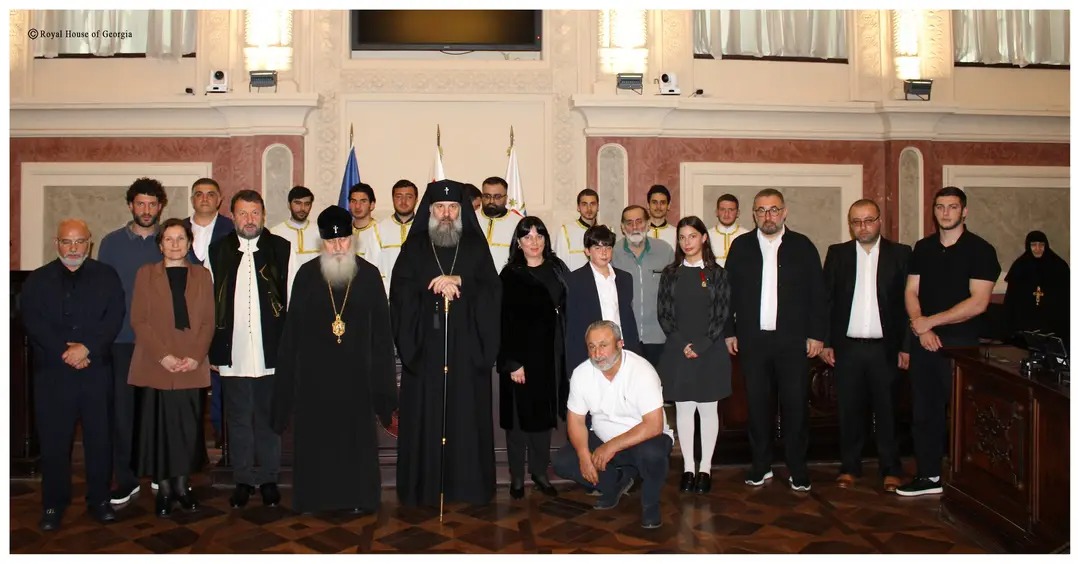
On May 12, the Day of Remembrance of St. Andrew the First-Called, a significant conference dedicated to the historic region of Lazeti (Lazistan) was held in the meeting hall of the Tbilisi City Assembly. Organized on the Royal House of Georgia initiative, the event brought together prominent spiritual and academic leaders.

The conference was opened with addresses by Patriarchal Locum Tenens Metropolitan Shio Mujiri and Metropolitan Daniel (Datuaashvili) of the Chiatura and Sachkhere Diocese, who delivered key speeches underscoring the spiritual and cultural importance of the occasion.

Distinguished participants included Metropolitan Anania (Japaridze) of Manglisi and Tetritskaro Diocese; Mr. Roin Metreveli, President of the Georgian National Academy of Sciences; and Her Royal Highness Princess Anna Bagrationi-Gruzinski, Head of the Royal House of Georgia.

In a historic declaration, His Eminence Metropolitan Anania Japaridze officially announced the reaffirmation of “Decree No. 2” issued in 2009 by the late Crown Prince Nugzar Bagrationi. According to this decree, his eldest daughter, Princess Anna, is declared the legal heir and successor as Head of the Royal House. This announcement marked the full recognition of Princess Anna’s role by Georgia's ecclesiastical and academic circles.

Earlier, the current President of Georgia and his government representatives attended Crown Prince Nugzar's funeral, symbolizing the state’s respectful acknowledgment of the royal legacy.

The conference concluded in a calm and respectful atmosphere, underlining the significance of the Royal House's historical role and the renewed support for Princess Anna’s leadership.


HRH Princess Irine and HRH Prince George Bagration, two of Princess Anna's three children


Princess Anna's father, Prince Nugzar Bragation Gruzinski, died on March 1, 2025. In 2009, she married Prince David Bagration Mukhrani, who claimed the long-defunct Georgian throne.    Within months, the couple separated due to Prince David's affair with a Georgian model.   They reconciled and in November 2010,  Princess Anna and Prince David remarried in a civil ceremony in Madrid.  Their only child, Prince George, was born in September 2011.  

The marriage, which had united the two main Georgian branches, was dissolved by divorce in 2013.

Thanks to the Royal House of Georgia for allowing me to use the photos.

Saturday, May 17, 2025

The Libtow twins - 2 new QVDS


Big sister Jerrine holds Waylon, and big brother Wulf holds Roscoe.


I learned about their births only a few hours after they were born, but I wanted to wait until the twins' mom, Saygan Habsburg Libtow, was ready to let me share the news.

Waylon and Roscoe Libtow, both photos @Saygan Habsburg Libtow


Waylon Walker and Roscoe Barrett Libtow were born on May 1, 2025 at St. Joseph's Hospital in Yipsilanti, Michigan.  They are the second and third children of Saygan Habsburg and her husband Mike Libtow.   They share a daughter, Jerrine, and Saygan has a son, Wulferic, from a previous relationship.

Waylon was born first. 

https://royalmusingsblogspotcom.blogspot.com/2021/02/a-new-qvd-welcome-to-world-jerrine-lee.html 

https://royalmusingsblogspotcom.blogspot.com/2012/01/newest-perhaps-qvd.html 


Victoria - Alfred - Marie - Ileana - Stefan - Christopher - Saygan - Waylon and Roscoe


Friday, May 16, 2025

Prince Georg Friedrich and Princess Sophie of Prussia attend funeral of Holocaust survivor Margot Friedländer


Embed from Getty Images 

 In Berlin yesterday, TI & RH Prince Georg Friedrich and Princess Sophie of Prussia today attended the funeral of activist and Holocaust survivor, Margot Friedländer, who died on May 19 at the age of 103.  

Embed from Getty Images 

Embed from Getty ImagesEmbed from Getty Images

 Prince Georg Friedrich and Margot Friedländer were close friends.  The Prince and Princess were accompanied by their four children, 12-year-old twins HI & RH Prince Carl Friedrich,  HRH Prince Louis Ferdinand,  HRH Princess Emma Marie, 10, and eight-year-old HRH Prince Heinrich.

According to the German press, this was the first time the four children had been seen in public. They were photographed greeting the German president Frank-Walter Steinmeier.

Prince Georg Friedrich, 38, heads the House of Prussia. 

https://www.nytimes.com/2025/05/10/world/europe/margot-friedlander-dead.html

Wednesday, May 14, 2025

Anita Rhinelander Stewart - An American Princess


Anita Stewart


Although he had an impressive lineage, Prince Miguel de Braganca would not have been described as a typical candidate to marry an American heiress. Not only was he perpetually short of funds, but he was also a prince without a country. Miguel was banned from entering Portugal because in 1826, his grandfather, King Miguel I, had usurped the throne from his young niece, Queen Maria II. The child queen succeeded to the throne after the death of her grandfather, João VI, and the renunciation of her father, Pedro, the Emperor of Brazil. The condition for his renunciation was for Miguel to marry his daughter. But Miguel, whose kingly ambitions were encouraged by his mother, was not content to be a Regent or King Consort.

 For six years, Portugal plunged into a Civil War that was deadlier than Spain's Carlist Wars. With the support of his adoring and domineering mother, Queen Carlotta Joaquina, the army, and nobility, King Miguel ruled as an absolute monarch. In 1831, many lives were lost when the king crushed two liberal uprisings. In Brazil, opposition to Dom Pedro's rule led to his abdication in favor of his son, Pedro. The former Emperor returned to Europe in a quest that would culminate in the restoration of Maria’s rights in September 1832. Dom Miguel continued to fight for the next two years, but peace was finally achieved in May 1834 when Miguel agreed to live in exile. Not only was Miguel required to renounce all rights to the throne for himself and his descendants, but he and his heirs were also barred from entering Portugal.

The former king settled in Germany and married Princess Adelheid of Löwenstein-Wertheim-Rosenberg in 1851. The couple had one son, Miguel, Duke of Braganza, and six daughters, whose marriages with members of the Bavarian, Austrian, Parma, and Luxembourg royal families brought the exiled Braganzas into closer contact with most of Europe’s royal families. The eldest daughter, Maria das Neves, married the Duke of San Jaime, the Carlist pretender to the Spanish throne.

The Duke of Braganza married twice. He had two sons, Miguel and Francisco José, and a daughter, Maria Teresa, by his first wife, Princess Elisabeth of Thurn und Taxis, a niece of Empress Elisabeth of Austria. Princess Elisabeth died several weeks after giving birth to their daughter.   The Duke of Braganza waited eleven years before he married again. His second wife was a first cousin, Princess Maria Theresa of Lowenstein-Wertheim-Rosenberg, by whom he had eight more children.

The family had lived at Schloss Bronnbach in Baden, Germany, for many years. In the 1860s, the duke bought Schloss Seebenstein, near Vienna, with money provided by the Dowager Duchess of Braganza's family. By 1909, the Seebenstein estate was heavily mortgaged.

In 1908, the Duke of Braganza began actively campaigning to restore his family's dynastic rights. He was interviewed by several Viennese papers, Die Zeit and Die Neue Frei Presse, in which he criticized King Carlos's reign and declared himself ready to accept "the throne of his father."

The duke was supported by his eldest sons. All three were commissioned officers in the Austrian army. The Duke was a colonel of the Hussars. Following the murders of King Carlos and Crown Prince Luiz Filipe that October, King Edward VII wrote to Franz Josef expressing his displeasure "that the emperor should allow a Portuguese revolution to be conducted from his capital."

 It was intimated that the duke's statements partially influenced the tragedy in Lisbon. Franz Joseph had allowed the exiled Braganzas to live in Austria. The family was also closely related to his sister-in-law, Archduchess Maria Theresa, the wife of Archduke Karl Ludwig, the Duke of Braganza's sister. Although the Duke was allowed to resign his commission, his two sons were summarily dismissed from their posts. Francisco José went to live in Paris, while Prince Miguel "spent much of his time on the fringe of London society looking for an heiress," according to The New York Times.

Several young American heiresses, collectively known as the dollar princesses, had secured titled husbands among the nobility of Britain and Continental Europe. However, despite the infusion of hard American cash into Europe's genealogically superior but cash-poor families, the marriages were far from fairytale events. By the early 1900s, a second generation of the dollar princesses was spending the seasons in London and Paris, where they, or at least their mamas, hoped to catch the eye of a very eligible (but not always wealthy) titled man. These young women were attractive and educated but naïve, and this naïveté appealed to many young British and European aristocrats. Of course, Daddy's healthy bank balance- and the promise of a huge dowry- did not hurt their chances to secure a titled husband.

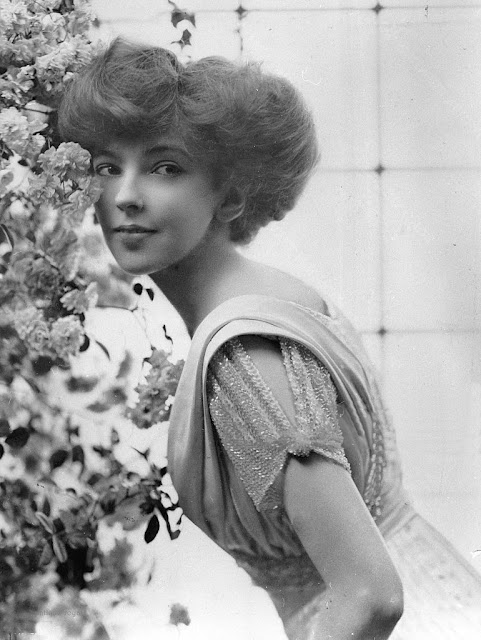
Anita Rhinelander Stewart was one of those women. She was born on August 7, 1886, in Elberon, New Jersey. She was one of two children of William Rhinelander Stewart and Annie McKee Armstrong. Anita descended from several of the most prominent New York Knickerbocker families. Her mother, “one of the most beautiful and admired" women in New York, was one of the city's great hostesses, and it was her attention to the social calendar that led to the couple's divorce in 1906. A lawyer by profession, William Rhinelander Stewart was actively involved in many philanthropic matters but was described as a "retiring man" averse to “society rather than courting it; contented with activities which do not create much noise in the world and deriving calm satisfaction from his studies and his books."

Enter James "Silent" Smith, a Wall Street financier and taciturn member of a social coterie centered in Bar Harbor, Maine, and Tuxedo, New York. Mr. and Mrs. William Rhinelander Stewart were among his closest friends. Some years before, James Smith had inherited more than $30 million from an eccentric uncle who fell asleep in the chair at his London club one afternoon and did not wake up for dinner.

Friends wondered what James planned to do with his new fortune. He built a great house in Tuxedo, took a parterre box at the opera, leased a townhouse on 57th Street in New York City, and became a patron of the arts. In 1904, he bought the late William C. Whitney‘s magnificent New York townhouse. Society mavens wondered who would become the mistress of his home. Not Mrs. Stuyvesant Fish II, his social mentor in Tuxedo, but Mrs. William Rhinelander Stewart, who had conducted a “sentimental friendship" with Smith for some years while her own marriage was foundering.

'William Rhinelander Stewart preferred his charities and municipal reform, while Annie loved parties, the exposure, and the highlights of New York society.

The Stewarts were divorced in August 1906. Less than a month later, Mrs. Stewart and her daughter Anita arrived in England on the Baltic. On September 13, 1906, Mrs. Stewart and Mr. Smith were married in a parish church in Inverness. The couple went out on a world tour and visited Kobe, Japan, when Smith, who suffered from Bright's Disease and a heart ailment, collapsed and died on March 27, 1907. The bulk of Smith’s estate was left to two nephews, but his widow received more than $3 million. Anita was also provided for, with Smith to leave her a $500,000 life interest in Chicago railroad stock and other ventures.

Encouraged by her socially prominent mother, Anita became one of the most eligible young American heiresses. It was unsurprising that her fortune would come to Dom Miguel's attention. In London and in Paris, the prince had courted several young American girls. Naturally, he was the subject of much gossip. It was averred that he had pursued Miss Beatrice Mills, but she married the Count of Granard instead.

 Prince Miguel was first introduced to Anita Stewart in Paris in April 1909, where he "was at once attracted by her." It was an assiduous courtship as Dom Miguel pursued Anita to London, where mutual friends arranged for the couple to see each other as often as possible. Their engagement was announced on July 9, 1909, at a concert dance hosted by Anita’s mother. Mrs. Smith had rented the Duchess of Somerset's Berkeley Square house for the season. The New York Times noted that a “noticeable number of Austrians were among the guests, and the entertainment was a very smart affair."  Mrs. Smith received her guests in black and wearing a superb string of pearls. Miss Stewart wore a "shimmering gown of pink chiffon over a cloth of silver."

 From his summer home in Bar Harbor, William Rhinelander Stewart told reporters he had no comment on his daughter's marriage. Anita Rhinelander Stewart's dowry was $1,000,000, which Smith had given to her after his marriage to her mother. Mrs. Smith added another million dollars to the dowry.

Dom Miguel's dynastic claims were shaky, but so were the questions concerning his marriage to an American. It was erroneously reported that Miguel had renounced his right to the Portuguese throne to obtain his father's consent for the marriage. Anita, however, was not going to settle for a morganatic marriage. She made it quite clear that she would not marry Miguel if the marriage were designated as unequal. The wealthy Miss Stewart also caught the eye of Emperor Franz Joseph. On September 6, it was announced that the Austrian emperor conferred on Miss Stewart the rank of Princess in her own right.

"It seems rather easier than we thought for an emperor to transform a plain American miss into a Princess when no principality goes with the title and no pecuniary endowment. In one editorial, " Miss Stewart is buying her own principality, and is expected to endow rather than being endowed," commented the New York Times.


The reports that Anita was made a Princess in her own right were incorrect. Franz Josef did nothing of the sort. However, he recognized her status "as determined by Portuguese rules of nobility."

Indeed, the forthcoming nuptials of the American heiress and the bankrupt Portuguese Prince were preceded by “an avalanche of breathless speculation by the New York newspapers" on the couple's chances of one day reigning in Portugal. At the time of their marriage, King Manoel II was unmarried, as was his heir presumptive, his uncle, the Duke of Oporto.

Several days before the wedding, Miguel gave a luncheon party at Claridge's Hotel for his bride-to-be. The Times regaled its readers with the report “that elaborate preparations are being made in Dingwall for the wedding” and that Miss Stewart was staying at Tulloch Castle, which her mother had rented for the shooting season. “The church is to be converted into a grotto, buying arrangement of evergreens and smilax, the sanctuary will be decorated with palms and white lilies, and the front of the choir will be decorated with the Braganca colors, ruby and blue."

 The wedding was nearly canceled because Anita refused to convert to Roman Catholicism. However, on the eve of the wedding, the matter was quietly settled, with Mrs. Smith agreeing to pay Miguel's massive debts.

The 31-year-old bridegroom’s gift to his bride was a feather cluster of diamonds and sapphires that had belonged to the Portuguese royal family for more than 200 years. King Miguel had presented the jewels to his daughter-in-law, Princess Elisabeth of Thurn und Taxis, when she married the Duke of Braganza. Dom Miguel inherited her jewels. The Duke of Braganza's sister-in-law, Archduchess Maria Theresa (the widow of Archduke Karl Ludwig) gave the bride 5 écaile blonde combs; another of Miguel's aunts, the Princess of Schwartzenberg gave a parasol.   Mrs. Smith gave her daughter a diamond tiara and a row of pearls. Anita presented her husband with a gold watch set in diamonds, a gold chain, and a gold locket set in diamonds.


The wedding occurred on September 15, 1909, at St. Lawrence Roman Catholic Church in Dingwall. The New York Times noted that this was the first royal wedding in Scotland since Mary Queen of Scots.   Coincidences abounded: both marriages had been performed by Bishop Chisholm; the bride descended from the Stewart kings, as did Prince Miguel, and the congregation of the little church was made up of descendants of those clans who were Catholic during the reign of Mary Queen of Scots.   The roads that led from Tulloch Castle to the little church were decorated with American, Austrian, and Portuguese flags. Anita would have noticed a sign that read “Long life and happiness to the prince and princess" as she was driven to the church.

Anita Stewart was a descendant of King James I of Scotland by his wife, Joan Beaufort, a granddaughter of John of Gaunt and Katherine Swynford. The details of the line of descent can be found in Americans of Royal Descent: A Collection of Genealogies of American Families Whose Lineage is Traced to the Legitimate Issue of Kings by Charles Henry Browning, published in 1891. https://books.google.com/books?id=dIUaAAAAYAAJ&pg=PA404&lpg=PA404&dq=lispenard+stewart&source=bl&ots=0k2SALr7Wv&sig=ACfU3U3AKUtFAwczbJx6WbeZ8jpnvuoKUQ&hl=en&sa=X&ved=2ahUKEwj2yfLR663hAhVPL6wKHYgQDjkQ6AEwDXoECAkQAQ#v=onepage&q=lispenard%20stewart&f=false]


The ceremony began at noon. To the strains of "The Wedding March" from Wagner's opera Lohengrin, the bride was escorted down the aisle by her tartan-clad brother William Rhinelander Stewart, Jr. There were no attendants. Anita "wore a graceful dress, carrying a long train of snow-white chiffon over soft satin." The chiffon was embellished by long lines of fine embroidery in white silk heather and tiny pearls, made up of sprays of heather, Fleur de Lis, and Portuguese devices."  Her veil was of old lace worn over a wreath of orange blossoms and heather and held in place by the feather clusters given to her by Prince Miguel. The bride also wore a set of combs, a gift from Archduchess Maria Teresa.

Attired in a Maltese uniform, “a brilliant scarlet Court dress, heavily decorated with gold, Miguel was supported by his younger brother, Prince Francisco José. The wedding ceremony lasted 20 minutes and was followed by a Low Mass. Bishop Chisholm, who said mass daily for the king and queen of Spain when they visited Scotland, pronounced the Pope‘s blessing for the couple.

The newlyweds and their guests return to Tulloch Castle for the wedding breakfast. The new Duke and Duchess of Viseu, as they were now officially styled, were driven to Inverness, where they caught the train for the south. They traveled to Vienna, where Emperor Franz Josef presented the new princess to the Austrian Court.

Miguel and Anita lived with her mother in London until she got tired of supporting Miguel's spendthrift ways. In June 1910, Anita gave birth to a daughter, Nada. Two years later, at Pippingford in Sussex, the couple's first son, John, was born. The outbreak of World War I forced the family, who were Austrian nationals, to seek refuge in Switzerland. Their third child, Miguel, was born in Berlin in September 1915.

Miguel abandoned his family to join the German army.   Anita and the three children remained in Switzerland until December 1919, when they sailed to New York on the Italian liner Pesario. The family was met at the pier by William Rhinelander Smith, who had not seen his daughter in 11 years, and her brother, William. The three little Braganza children wore sailor costumes with pilot coats and brass buttons. Seven-year-old Prince John told reporters, “Yes, we had Christmas on board, but there were not many gifts."   Anita said she planned to remain in America indefinitely, but added that her husband would stay in Switzerland due to his status as an “ex-territorial."   Her brother denied that his sister and her husband were estranged, adding that “they were very much attached to each other."

Eventually, Prince Miguel, who had trained as a broker in London before the war, was reunited with his wife and children in New York. In November 1922, he started working as a salesman with John C. Paige & Co., an insurance firm in which his brother-in-law was a member.   Returning to Europe to live was out of the question. Austria was now a republic, and its royal family- Miguel's cousins- were in exile.

A revolution in 1910 ended the Portuguese monarchy. King Manoel II was living in England with his wife, Princess Augusta Victoria of Hohenzollern, whom he had married in 1913. The couple had no children. In 1917, the Duke of Oporto married an American woman, Nevada Hayes. This marriage was also childless. The Duke of Braganza's descendants could return to Portugal if the Portuguese throne were restored. In July 1920, the Duke of Viseu waived all rights to the putative Portuguese throne for himself and his descendants. A week later, his elderly father renounced his rights in favor of his third son, Dom Duarte.

King Manoel II had never given his approval for marriage. By the late 1920s, after the deaths of Prince Miguel and his father, Anita and her children's status changed. This was noted in the Almanach de Gotha. Until the volume was published in 1927, Anita's three children were listed with their full names and titles. However, after 1927, the Gotha included the marriage but did not provide details about the children, except that the couple had two sons and one daughter.   This change was due to the relationship between King Manoel II and Dom Duarte, the younger half-brother of Prince Miguel. Following his father's death, he succeeded to the title of Duke of Braganza on October 11, 1927. The plans were in place for the new Duke, who was only 20 years old, to be recognized as Manoel II's heir.

Anita's descendants have no dynastic rights to the Portuguese throne.

[After King Manoel II died in 1932, Dom Duarte's rights were assured when Portuguese monarchists acknowledged him as King Duarte I. In 1950, Portugal’s National Assembly lifted the ban against the descendants of King Miguel. The current head of the house is Dom Duarte's eldest son, Duarte, Duke of Braganza, who lives in Lisbon with his wife and two children.]

 In February 1923, Anita and Miguel were staying at her brother's residence in New York when Miguel suffered a severe attack of influenza. As Miguel responded to treatment, Anita left for Newport, Rhode Island, to visit their summer home, the Moorings. His condition quickly worsened when he developed double pneumonia, and Anita was summarily recalled from Newport.

One of his childhood friends, Count Laszlo Széchényi Sárvár-Felsövidék, who was Hungary's Minister to the United States, came from Washington, D.C., to see him. Anita's brother returned from his winter home in Palm Beach, Florida. All three were at Miguel's bedside when he died at 2:00 a.m. on February 21. Funeral services were held at the Stewart home. A High Mass was solemnized at the church of Saint Vincent Ferraro, and, at his expressed wish, Miguel was buried at Bronnbach in Baden.

Anita's mother, Annie, who had married for a third time in 1915 to Jean St. Cyr, died in California in 1925. She left an estate worth $40 million, of which one-third was left to her younger husband. Nearly $250,000 of the estate was given to Prince Alexander of Thurn und Taxis, a cousin of Prince Miguel. The money he received represented a share of securities valued at $50,000 that Mrs. Smith had turned over to the Girard Trust Company in 1913. Alexander received a share of this trust as Miguel had been indebted to his cousin for $55,936. At that time, Anita assigned to Prince Alexander an interest "amounting to about $240,000, effective upon Mrs. St. Cyr's death."    She had made the assignment to pay her husband's cousin after her mother's death. Alexander accepted the assignment and released Miguel from "all liability on the judgments."

Anita inherited the rest of her mother's estate. In March 1926, she regained American citizenship after renouncing her royal titles in the Superior Court in Newport. Although her legal name became Anita de Braganca, she was still considered Princess Anita, especially socially. Several years later, in an action that surprised many in her social circle, Anita opened a photography studio in New York City, which she operated for many years.

Her father died in September 1929. Anita and her brother were heirs to their father's estate and received a percentage of the residue and two trusts from their father's older brother, Lispenard Stewart, who died in 1927.

She maintained contact with her husband's family in Europe. In 1934, Anita officially announced her half-sister-in-law, Princess Maria Antonia's engagement to Harvard graduate Ashley Chandler.

Maria Antonia had come to the United States in the summer of 1933 to be a bridesmaid at the marriage of Agnes Clark in San Mateo, California. She enjoyed visiting the States so much that she remained with friends in Bar Harbor. She also spent time with Anita and her family at their home in Newport. Ashley Chanler, a descendant of   John Jacob Astor, had met his future wife on board the Europa. They married on June 14, 1934, at Schloss Seebenstein, but resided in New York City.

On April 10, 1946, Anita, whom the New York Times described as Princess de Braganca, married Lewis Gouverneur Morris at St. Ann's Episcopal Church in the Bronx. Morris, a "member of a family long identified with society here (NYC) and in Newport," was a descendant of several colonial American families. He was a former banker who served time in prison in 1921 after his brokerage firm failed. His first wife, Nathalie Lorillard Bailey, died in 1935.

The newlyweds divided their time between Malbone Castle in Newport and a residence at 1510 Park Avenue in New York City.

The joy of her marriage was soon tempered by the death of her only daughter, Nada, who had been married twice and committed suicide, leaving behind a teenage son. John and Miguel became American citizens. John settled in Winston-Salem, North Carolina, and Miguel, an airline pilot, raised his family in Bedford Hills, New York. The two brothers and their families also maintained winter homes in Palm Beach, Florida. John died in 1991, and Miguel passed away at his home in Palm Beach in February 1996.

Malbone Castle @Marlene Koenig

Lewis Morris died at Malbone Castle after a lengthy illness.

Anita spent her final years at her homes in Newport and Palm Beach. She died on September 15, 1977, the 66th anniversary of her first marriage, at Malbone Castle in Newport.

@Marlene Koenig

Anita and Lewis are buried next to each other in the cemetery at St. Columba Episcopal Church in Middletown, Rhode Island.


[Anita was not the only member of her family to marry into foreign nobility and royalty. Her maternal first cousin, Margaretta Armstrong Drexel, the daughter of Alexander Drexel of Philadelphia and Margarita Armstrong, married Guy Finch-Hatton,14th Earl of Winchilsea and 9th Earl of Nottingham, in 1910. Their eldest son, Christopher, the 15th Earl of Winchilsea, married Countess Gladys Széchényi Sárvár-Felsövidék, the 3rd of five daughters of Count Laszlo  Széchényi Sárvár-Felsövidék and Gladys Vanderbilt. Laszlo was Prince Miguel's childhood friend.]

An earlier version of this article was published in 1996 in Royalty Digest.

If you enjoyed this article


Kennedy memorial at Runnymede dedicated by Queen Elizabeth II

May 14, 1965

The New York Times reports that today, a "little corner of the English meadow where the idea of constitutional government first stirred 750 years ago" was dedicated to the "memory of President Kennedy."


In a "simple ceremony,"  Queen Elizabeth II "bequeathed three acres to the American people as a memorial" to President Kennedy, who was assassinated last November 22, while on a visit to Dallas, Texas.

In 1215 at Runnymede, the barons of England forced King John to sign the Magna Carta.  The king was "henceforth bound to observe certain liberties of his subjects," a concept whose power is still felt in world politics.


President Kennedy's widow, Jacqueline, wearing white, "sat silently through the ceremony, composed as ever, displaying no emotion."

This was not a "funereal occasion," although there was sadness and memories, with the talk of history and John F. Kennedy's "place in it."  It was a warm day, the "sun was out, bright and hot," and the temperature was in the eighties.

Arrangers chose not to make the ceremony too somber. Mrs. Kennedy waited for the queen with her two children, Caroline, 7, and 4-year-old John. The late president's brothers, Senators Robert F. and Edward M. Kennedy, and two of their sisters, Mrs. Peter Lawford and Mrs. Stephen Smith, were also present. 

They met the Queen and the Duke of Edinburgh and walked together up a slope, nearly a quarter of a mile, to the memorial site.

They stood silently for several moments in front of a "simple memorial stone that had been placed in a curve of the hill."  The inscription reads: "This acre of English ground was given to the United States of America by the people of Britain in memory of John F. Kennedy, President of the United States, 1961-63, died by an assassin's hand, 22 November 1963. 

"Let every nation know whether it wishes us well or ill that we shall pay any price, bear any burden, meet any hardship, support any friend or oppose any foe in order to assure the survival and success of liberty."

As the small group stood before the monument, Caroline Kennedy held her mother's hand on one side, and the "queen's hand on the other.  The Duke of Edinburgh held John Kennedy's hand.

Prime Minister Macmillan pointed out that this gift was not the "main gift" of the British people in the late President's memory.  They have donated more than $2.3 million for scholarships to allow young Britons to study at American universities.

The Runnymede memorial was one of "many proposals" received by the Kennedy Memorial Trust.   Although the author of the idea has not been named, it is understood that this was Queen Elizabeth's idea.


Secretary of State Dean Rusk accepted the gift of land for the United States.

After the ceremony, Mrs. Kennedy and her party were driven to Windsor Castle, where they had tea with the Queen and Prince Philip.

Tuesday, May 13, 2025

Royal Compound in Dedinje is open for the 2025 season


all photos courtesy of HRH Crown Prince Alexander


I have had the pleasure of visiting the palace for several events as Crown Prince Alexander's guest. Belgrade is a lovely city, and I recommend this tour.

"Belgrade, 13 May 2025—The Royal Compound in Dedinje is again open for tours. As always, the first visitors in the 2025 Season were media representatives, who, accompanied by professional tour guides from the Royal Palace, had the opportunity to learn about the interesting history and rich tradition of this building, one of the most beautiful adornments of the Serbian capital.


The hosts, HRH Crown Prince Alexander and HRH Crown Princess Katherine, due to unavoidable obligations abroad, were unable to personally welcome the press teams to their home this year for the first time, but on this occasion a letter of greeting from His Royal Highness was read, in which the Crown Prince expressed his great pleasure that the Palace is again welcoming visitors. This year's tourist season was officially opened by Mr. Miodrag Popović, Director of the Belgrade Tourist Organization, who once again emphasized that the Royal Complex is one of Belgrade's biggest tourist attractions and that there is always enormous interest in its tours.

“The Karađorđevićs are a dynasty that originated from our people, shared the same fate with our nation, and therefore our personal past, as well as the past of our home, cannot be viewed separately and independently from Serbian history. They are intertwined and complement each other. The Royal Compound is a wonderful place, full of interesting stories and anecdotes that enchant and fulfil every visitor. During the past times, it was also a place of great joy, family warmth, and love, but also a place of important events and crucial decisions that fateful determined the direction in which our country was going. Both the Royal Palace, which will celebrate its centenary in four years, and the slightly younger White Palace, remember how my father, King Peter II, played here with his brothers, Princes Tomislav and Andrew, how they threw snowballs at each other in the meadow in front of their home during the winter, or rode in a small boat in the pool in front of the Royal Palace in the summer, how they studied here, gained their first knowledge, grew up... But it also remembers my grandfather, King Alexander I, who met here with Louis Barthou, the French Minister of Foreign Affairs, just a few months before they both fell as victims of assassination. It also remembers more than 150 bombs that fell on our family home and its surroundings on 6 April 1941.


The examples are countless, and these are just some of the stories that visitors who come here can hear. That is why many of them say that when they pass through the gates of the Complex, it is as if they have stepped back several decades, into another era. This is precisely why we reopen the Palace for visitors every year. So that our countrymen, but also numerous friends from abroad, can see the Royal Complex in Dedinje, a steady and constant witness to our history and tradition, to get to know this magnificent estate that our country can be proud of, the guardian of the legacy of the Knightly King Alexander and the entire House of Karađore”, said HRH Crown Prince Alexander in his letter.

Media representatives who found themselves as tourists today got to know the home of the Royal Family of Serbia better and visited everything that a standard tour includes - the Royal Palace, the White Palace, the Palace Chapel of St. Andrew the First-Called, and the Royal Park. The tour is a pleasant walk lasting approximately one and a half hours, to get in touch with the history, rich heritage and cultural legacy of our country and the Karađorđević dynasty. By the way, before the return of the Royal Family to Serbia, the Palace complex was a kind of "forbidden city", closed to the public for decades, and opening it for the visitors was one of the first important decisions of the head of the Royal Family, HRH Crown Prince Alexander, of which he is particularly proud.


Mr. Popоvic, Director of the Tourist Organization of Belgrade, said: “When we talk about tourist destinations, the first thing that comes to mind for many is beautiful beaches or high mountain peaks. However, what really makes a place unique and worth visiting is its culture and history. It is precisely these two dimensions that provide a deeper meaning to travel and make the difference between a passing attraction and an unforgettable experience. Cultural and historical heritage represents the greatest treasure of a tourist destination, increases its recognition on the global map, and contributes to the sustainable development of tourism. It also encourages the local population to preserve and respect their heritage, knowing that it is valuable not only for them, but also for the entire world. Traditional visits to the Royal Complex therefore, represent an important segment of Belgrade's tourist offer, a traditional and permanent value to which we return every year.”

The tourists will also, when it is available due to their obligations, be greeted by Crown Prince Alexander and Crown Princess Katherine. "


The Tourist Organization of Belgrade (TOB) organizes visits to the Royal Complex every weekend on Saturdays at 9:30 am and 12:30 pm. Ticket purchased from the Tourist Organization of Belgrade includes organized bus transportation from the marked tourist bus stop on Terazije Square, in front of the Terazije Fountain, to the Royal Complex - gatherings for transport are at 9:30 am and 12:30 pm. The ticket price is 1,500 RSD. The number of people in a group is restricted to a maximum of 30 visitors. 

For information and reservations, tourists should visit the Tourist Information Centre in Belgrade, Knez Mihailova 56, phone: +38111 26 35 622, e-mail: bginfo.knezmihailova@tob.rs, website www.tob.rs

Schools, students, and pensioner associations can visit the Royal Palaces in Dedinje in announced group visits every working day from 9:00 am to 3:00 pm with the mandatory notification to the Office of HRH Crown Prince Alexander at least 7 to 10 days ahead, over the phone +381 11 306 4014 or via e-mail: kancelarija@dvor.rs. Each group must consist of at least 10 visitors and up to a maximum of 40 visitors per group. Website: www.dvor.rs