March 10, 1958
Prince Gaetan of Bourbon-Parma died yesterday in a hospital in Cannes. He was 52 years old. A resident of Luxembourg, the prince was a younger brother of the former Empress Zita of Austria. In 1931, Gaetan married Princess Margarete of Thurn und Taxis. The marriage ended in divorce in 1950. They had one daughter, Diane.
He "was wounded six times" while serving with Franco's in the Spanish civil war. He fled Europe in 1941 for the United States, where he was drafted into the United States Army two years later, the AP reported.
Wednesday, March 10, 2010


Josephine Charlotte arrives in Belgium to vote for monarchy
March 10, 1950
Princess Josephine Charlotte of Belgium, the "pretty blond 22-year old" daughter of King Leopold III, arrived today in Brussels from Switzerland. She will cast her vote for her father in Sunday's national referendum on whether Leopold "should be "restored to the throne."
According to the New York Times, "about 5,000 semi-hysterical Leopoldists mobbed the plane at the Brussels airport and imprisoned the Princess and thirty-one other passengers for forty-five minutes."
The police had to use "rifle butts" as they tried to drive back the crowd so the Princess could depart the plane. Firemen threatened "to douse the mob with a hose," but none of this helped. Eventually, Josephine Charlotte was able to depart the plane when her car was brought to the steps of the plane.
Those opposed to Leopold's return charged that the Princess "was being brought to Belgium only as a last-minute campagin maneuver."
It has been conceded that Leopold's return "would be a fairly simple matter if he could get a substanial majority of 70 percent." Nothing less would lead to "further acrimonious struggles in Parliament," according to Belgian political leaders.
The vote is "actually only advistory as Parliament alone has to the power" to decide Leopold's fate. The King has said that he would "abdicate in favor of Prince Baudouin, his son," he he received less than 55 percent of the voters in favor of his return.
Princess Josephine Charlotte of Belgium, the "pretty blond 22-year old" daughter of King Leopold III, arrived today in Brussels from Switzerland. She will cast her vote for her father in Sunday's national referendum on whether Leopold "should be "restored to the throne."
According to the New York Times, "about 5,000 semi-hysterical Leopoldists mobbed the plane at the Brussels airport and imprisoned the Princess and thirty-one other passengers for forty-five minutes."
The police had to use "rifle butts" as they tried to drive back the crowd so the Princess could depart the plane. Firemen threatened "to douse the mob with a hose," but none of this helped. Eventually, Josephine Charlotte was able to depart the plane when her car was brought to the steps of the plane.
Those opposed to Leopold's return charged that the Princess "was being brought to Belgium only as a last-minute campagin maneuver."
It has been conceded that Leopold's return "would be a fairly simple matter if he could get a substanial majority of 70 percent." Nothing less would lead to "further acrimonious struggles in Parliament," according to Belgian political leaders.
The vote is "actually only advistory as Parliament alone has to the power" to decide Leopold's fate. The King has said that he would "abdicate in favor of Prince Baudouin, his son," he he received less than 55 percent of the voters in favor of his return.
King Michael arrives in New York
March 10, 1948
Former King Michael of Roumania arrived today in New York. He and his mother, Queen Helen, had traveled aboard the Queen Elizabeth. This is their first visit to the United States.
Michael, who still considers himself the "rightful ruler of Romania," was "poised and smiling," as he answered questions from about 150 reporters and photographers, reported the AP.
He indicated that he hoped to marry Princess Anne of Bourbon-Parma, acknowledging the religious issues. The princess is Roman Catholic, and Michael is a member of the Orthodox church. He also believes that he will "eventually regain his throne." Most of the questions were about how he would "attain his aims." The king, smiling, said, "I wouldn't know."
Michael and his mother will be in the United States for about three weeks, but they do not have a defined itinerary set up.
Michael was asked if Romanian Communists forced his abdication. His answer was an emphatic "Yes." Another reporter asked if Pope Pius XII's refusal to allow Anne to marry Michael would prevent the marriage from taking place.
"I'll have to get back first and ask her. We hope to be married in Copenhagen but we don't know when."
Michael referred to the meeting between the Pope and Queen Helen and Princess Margarethe, as a "court call, one of courtesy, and there was no question of a dispensation."
He was also asked if war was the only way to rid Romania of communism. Michael answered: "Not in the present circumstances."
Michael and Helen left Romania with only "personal belongings" and little money. He was asked if he would look for a job and "whether he would like something connected with mechanics."
"Well, I've driven an automobile since I was young." Queen Helen then interjected: "Yes, he has frightened the wits out of me since he was 6 years old."
"I hope to visit industrial plants in this country, but I do not know where. I hope to visit the Middle West if I have enough time."
Michael also said that "he wanted to know the Americans." He added that he wanted to visit the United Nations and meet with Romanians who are in the United States, and he "would welcome the opportunity" to meet with officials in Washington. Michael said that he had not thought about establishing a government-in-exile, although Gen. Nicholas Radescu, the former Prime Minister of Romania, "led a delegation of Rumanian-Americans down the bay to greet" Michael. In Roumanian, the general said that he "believed the young king would be a rallying figure for the people of Rumania here."
The king said he did not see any Russians on the day he abdicated. The press wanted to know if he left voluntarily or was "forced out" after Petru Groza, Romania's premier "insisted on the abdication?"
He responded" "They didn't say it, but it felt like that." He did not believe that Groza was a "loyal Rumanian," but declared that "all the Rumanian people, in his opinion, were loyal to their King."
Michael was also asked about the Foreign Minister, Ana Pauker, a committed Communist. Michael smiled when he was asked if Ana was a cruel woman? His retort: "Look at her photograph."
The interview took place in the ship's veranda grill, "where tables had been removed and chairs of arranged for the interview." When the interview was over, the king "admitted with a rueful smile that he had never experienced such a press interview before," the New York Times reported. No, nothing, "of this kind," Michael said.
Former King Michael of Roumania arrived today in New York. He and his mother, Queen Helen, had traveled aboard the Queen Elizabeth. This is their first visit to the United States.
Michael, who still considers himself the "rightful ruler of Romania," was "poised and smiling," as he answered questions from about 150 reporters and photographers, reported the AP.
He indicated that he hoped to marry Princess Anne of Bourbon-Parma, acknowledging the religious issues. The princess is Roman Catholic, and Michael is a member of the Orthodox church. He also believes that he will "eventually regain his throne." Most of the questions were about how he would "attain his aims." The king, smiling, said, "I wouldn't know."
Michael and his mother will be in the United States for about three weeks, but they do not have a defined itinerary set up.
Michael was asked if Romanian Communists forced his abdication. His answer was an emphatic "Yes." Another reporter asked if Pope Pius XII's refusal to allow Anne to marry Michael would prevent the marriage from taking place.
"I'll have to get back first and ask her. We hope to be married in Copenhagen but we don't know when."
Michael referred to the meeting between the Pope and Queen Helen and Princess Margarethe, as a "court call, one of courtesy, and there was no question of a dispensation."
He was also asked if war was the only way to rid Romania of communism. Michael answered: "Not in the present circumstances."
Michael and Helen left Romania with only "personal belongings" and little money. He was asked if he would look for a job and "whether he would like something connected with mechanics."
"Well, I've driven an automobile since I was young." Queen Helen then interjected: "Yes, he has frightened the wits out of me since he was 6 years old."
"I hope to visit industrial plants in this country, but I do not know where. I hope to visit the Middle West if I have enough time."
Michael also said that "he wanted to know the Americans." He added that he wanted to visit the United Nations and meet with Romanians who are in the United States, and he "would welcome the opportunity" to meet with officials in Washington. Michael said that he had not thought about establishing a government-in-exile, although Gen. Nicholas Radescu, the former Prime Minister of Romania, "led a delegation of Rumanian-Americans down the bay to greet" Michael. In Roumanian, the general said that he "believed the young king would be a rallying figure for the people of Rumania here."
The king said he did not see any Russians on the day he abdicated. The press wanted to know if he left voluntarily or was "forced out" after Petru Groza, Romania's premier "insisted on the abdication?"
He responded" "They didn't say it, but it felt like that." He did not believe that Groza was a "loyal Rumanian," but declared that "all the Rumanian people, in his opinion, were loyal to their King."
Michael was also asked about the Foreign Minister, Ana Pauker, a committed Communist. Michael smiled when he was asked if Ana was a cruel woman? His retort: "Look at her photograph."
The interview took place in the ship's veranda grill, "where tables had been removed and chairs of arranged for the interview." When the interview was over, the king "admitted with a rueful smile that he had never experienced such a press interview before," the New York Times reported. No, nothing, "of this kind," Michael said.
Boris meets with Americans
March 10, 1926
King Boris of Bulgaria "set a new precedent of the great powers," last night, as a guest of the American Legation in Sofia, according to an AP dispatch. The king was accompanied by his sister, Princess Eudoxia. The king spoke to the American Minister, Charles B. Wilson in French, while the princess "proved herself fluent in English."
King Boris of Bulgaria "set a new precedent of the great powers," last night, as a guest of the American Legation in Sofia, according to an AP dispatch. The king was accompanied by his sister, Princess Eudoxia. The king spoke to the American Minister, Charles B. Wilson in French, while the princess "proved herself fluent in English."
Stephanie to give up tiaras when she marries poor Hungarian count
March 10, 1900
It appears that the oft-postponed marriage of Crown Princess Stephanie of Austria to Count Lonyay will soon take place in Trieste, according to the New York Times. Count Lonyay "has taken a residence" in Trieste, and Stephanie, widow of the late Crown Prince Rudolph, departed by train from Vienna on Thursday.
Neither the Viennese or Brussels court are "favorably disposed toward the groom than when the marriage was first mooted." King Leopold II of the Belgians "thinks it a scandal only a little less terrible than that of his eldest daughter," Princess Louise. Stephanie's mother, Queen Henriette Marie "hides her head in shame."
When Stephanie marries her Hungarian count, she will throw up her "Court life, tiaras, diamonds and gold-embroidered robes," and her income will be reduced from 800,000 crowns to 200,000 crowns, and she will live "with a poor country gentleman."
The Viennese "scarcely talk of anything else, but this great sacrifice for the sake of love."
It appears that the oft-postponed marriage of Crown Princess Stephanie of Austria to Count Lonyay will soon take place in Trieste, according to the New York Times. Count Lonyay "has taken a residence" in Trieste, and Stephanie, widow of the late Crown Prince Rudolph, departed by train from Vienna on Thursday.
Neither the Viennese or Brussels court are "favorably disposed toward the groom than when the marriage was first mooted." King Leopold II of the Belgians "thinks it a scandal only a little less terrible than that of his eldest daughter," Princess Louise. Stephanie's mother, Queen Henriette Marie "hides her head in shame."
When Stephanie marries her Hungarian count, she will throw up her "Court life, tiaras, diamonds and gold-embroidered robes," and her income will be reduced from 800,000 crowns to 200,000 crowns, and she will live "with a poor country gentleman."
The Viennese "scarcely talk of anything else, but this great sacrifice for the sake of love."
Tuesday, March 9, 2010
Margaretha's engagement is postponed
March 9, 1958
The engagement between Princess Margaretha of Sweden, 23, and her British suitor, Robin Douglas-Home, 25, a nightclub pianist, has been postponed, court officials told Reuters and other news organizations.
An official court statement says that Douglas-Home, described as a "London blue blood," will leave Stockholm tomorrow but is expected to "return soon."
King Gustav VI Adolf is concerned about his granddaughter's "future happiness." He would put no "obstacles in their path," if Robin and Margaretha were absolutely sure about their feelings.
The engagement between Princess Margaretha of Sweden, 23, and her British suitor, Robin Douglas-Home, 25, a nightclub pianist, has been postponed, court officials told Reuters and other news organizations.
An official court statement says that Douglas-Home, described as a "London blue blood," will leave Stockholm tomorrow but is expected to "return soon."
The official court announcement "made no reference to an engagement," and there was "no question of Douglas-Home having been turned down by the royal family." A family spokesman said the engagement of a princess is "an extremely serious affair."
King Gustav VI Adolf is concerned about his granddaughter's "future happiness." He would put no "obstacles in their path," if Robin and Margaretha were absolutely sure about their feelings.
Douglas-Home, a nephew of the Earl of Home, arrived in Sweden five days ago to "ask formally for Margaretha's hand." They met last winter when Margaretha was in London "to brush up on her English. At the time, Robin was playing the piano in a London bar, a job "he quit at the suggestion of the Swedish court for a more dignified position with a publishing firm."
Last spring, the couple parted "at the urging of the Swedish king." They wrote to each other but did not meet again until this past week when Douglas-Home arrived in Sweden.
Robin was introduced to her family at an informal luncheon: her mother, Princess Sybilla; her three sisters, Princesses Birgitta, 21, Desiree, 19, and Christina, 14; and her brother, Crown Prince Carl Gustav, 12.
King Gustav VI Adolf had a half-hour conversation with Douglas-Home on Friday, and yesterday the king "took the couple for a drive in his car." Earlier today, Douglas-Home arrived at the palace and stayed for lunch, where it was reported that he "made an excellent impression" on Margaretha's family.
The Swedish newspaper, Aftonbladet's court reporter, said that "romance between the Princess and the British blue blood" is not on the rocks.
"The royal family has had the courage to leave the decision to the youngsters themselves," the paper reported. Margaretha and Robin were "advised to think it over they have decided on the postponement voluntarily. Robin may also meet the Princess abroad so they can make up their minds on their marriage plans in peace."
Robin had proposed to the princess last spring, but her mother, Princess Sybilla, wrote to him, "that such a marriage was unthinkable."
The match was considered "unsuitable" because Douglas-Home earned only $126 a week, which was not enough to support a royal princess. Margaretha was ordered home, but the young couple kept in touch. After Robin secured a new, more stable position, he was invited to Sweden, where the king's son, Prince Bertil, officially introduced him to the king. He was also "fully accepted" by the court.
Last spring, the couple parted "at the urging of the Swedish king." They wrote to each other but did not meet again until this past week when Douglas-Home arrived in Sweden.
Robin was introduced to her family at an informal luncheon: her mother, Princess Sybilla; her three sisters, Princesses Birgitta, 21, Desiree, 19, and Christina, 14; and her brother, Crown Prince Carl Gustav, 12.
King Gustav VI Adolf had a half-hour conversation with Douglas-Home on Friday, and yesterday the king "took the couple for a drive in his car." Earlier today, Douglas-Home arrived at the palace and stayed for lunch, where it was reported that he "made an excellent impression" on Margaretha's family.
But there was one discordant note to Margaretha's romance. This came from Robin's father, Maj. Henry Douglas-Home, who noted "Robin and his problems and with the Swedes in general." He said that his son was being made a "door mat," and he added: "If she's worth her salt, she'll marry him now, or never, and on his terms. Otherwise, their life will be a Swedish misery."
The Swedish newspaper, Aftonbladet's court reporter, said that "romance between the Princess and the British blue blood" is not on the rocks.
"The royal family has had the courage to leave the decision to the youngsters themselves," the paper reported. Margaretha and Robin were "advised to think it over they have decided on the postponement voluntarily. Robin may also meet the Princess abroad so they can make up their minds on their marriage plans in peace."
Robin had proposed to the princess last spring, but her mother, Princess Sybilla, wrote to him, "that such a marriage was unthinkable."
The match was considered "unsuitable" because Douglas-Home earned only $126 a week, which was not enough to support a royal princess. Margaretha was ordered home, but the young couple kept in touch. After Robin secured a new, more stable position, he was invited to Sweden, where the king's son, Prince Bertil, officially introduced him to the king. He was also "fully accepted" by the court.
Belgian sovereigns to fly to Denmark
March 9, 1928
For the "first time in history," the Belgian king and queen "will travel by air" when they fly to Copenhagen for an official visit to Denmark. King Albert I has "directed that the entire royal party" journey "by planes in a single flight," the New York Times reports today.
The official delegation will include King Albert and Queen Elisabeth, and their two younger children, Prince Charles and Princess Marie José, as well as the king's staff and his equerry.
For the "first time in history," the Belgian king and queen "will travel by air" when they fly to Copenhagen for an official visit to Denmark. King Albert I has "directed that the entire royal party" journey "by planes in a single flight," the New York Times reports today.
The official delegation will include King Albert and Queen Elisabeth, and their two younger children, Prince Charles and Princess Marie José, as well as the king's staff and his equerry.
Grand Duke Michael arrested
March 9, 1918
The United Press staff correspondent in Petrograd is reporting that Grand Duke Michael of Russia, the younger brother of the former Czar, was arrested last night. The arrest took place in Petrograd, formerly known as St. Petersburg, after the "discovery of a German plot to restore the monarchy and place him on the throne." Several "Russian officers and Georgian cavaliers" were also arrested.
The Grand Duke is being held at the Smolny Insitute. His part in "the conspiracy is not known."
In contrast to this story, the New York Times is reporting "that it is stated in the newspapers that the Bolshevist Government has been granted complete freedom to Grand Duke Michael Alexandrovich. "According to this report, Grand Duke Michael has been "under arrest at his home."
Michael was named regent following the abdication of his brother, Nicholas II, who abdicated in March 1917 for himself and for his only son, Alexis. Last September, Michael and his wife were arrested, after it was "alleged that they were concerned in a monarchist plot."
The United Press staff correspondent in Petrograd is reporting that Grand Duke Michael of Russia, the younger brother of the former Czar, was arrested last night. The arrest took place in Petrograd, formerly known as St. Petersburg, after the "discovery of a German plot to restore the monarchy and place him on the throne." Several "Russian officers and Georgian cavaliers" were also arrested.
The Grand Duke is being held at the Smolny Insitute. His part in "the conspiracy is not known."
In contrast to this story, the New York Times is reporting "that it is stated in the newspapers that the Bolshevist Government has been granted complete freedom to Grand Duke Michael Alexandrovich. "According to this report, Grand Duke Michael has been "under arrest at his home."
Michael was named regent following the abdication of his brother, Nicholas II, who abdicated in March 1917 for himself and for his only son, Alexis. Last September, Michael and his wife were arrested, after it was "alleged that they were concerned in a monarchist plot."
Rupprecht to marry Anna of Austria
March 9, 1900
The Marquise de Fontenoy's latest column in the Chicago Tribune features a report on the engagement of Prince Rupprecht of Bavaria to Archduchess Anna of Austria, daughter of the former Grand Duke of Tuscany and niece of the missing Archduke Johann, who was known as John Orth. The Marquise notes that Rupprecht is the heir presumptive to the Bavarian throne, "now occupied by his lunatic cousin, Otto," but he is also the "legitimist heir to the British throne." His mother, Princess Ludwig of Bavaria, is "at the present moment the most senior living representative of the English royal Stuart dynasty." Rupprecht apparently does not share the enthusiasm for the "English legitimists who each year celebrate the anniversary of the execution of Charles I," and who consider Queen Victoria an usurper.
Prince Rupprecht represented Bavaria at Queen Victoria's "jubilee a few years ago, and while in London experienced annoyance and trouble in avoiding the altogether unwelcome attention" from the English legitimists.
Prince Rupprecht is a "stalwart, square-shoulder, tall and good looking young Prince, far more comely than the other members of his family." He has 'settled down into a respectable, studious and sensible scion of royalty, with a strong disposition towards scientific problems."
The prince's fiancee "belongs to that particular branch of the house of Hapsburg which is famed for its brilliancy and originality."
The Marquise de Fontenoy's latest column in the Chicago Tribune features a report on the engagement of Prince Rupprecht of Bavaria to Archduchess Anna of Austria, daughter of the former Grand Duke of Tuscany and niece of the missing Archduke Johann, who was known as John Orth. The Marquise notes that Rupprecht is the heir presumptive to the Bavarian throne, "now occupied by his lunatic cousin, Otto," but he is also the "legitimist heir to the British throne." His mother, Princess Ludwig of Bavaria, is "at the present moment the most senior living representative of the English royal Stuart dynasty." Rupprecht apparently does not share the enthusiasm for the "English legitimists who each year celebrate the anniversary of the execution of Charles I," and who consider Queen Victoria an usurper.
Prince Rupprecht represented Bavaria at Queen Victoria's "jubilee a few years ago, and while in London experienced annoyance and trouble in avoiding the altogether unwelcome attention" from the English legitimists.
Prince Rupprecht is a "stalwart, square-shoulder, tall and good looking young Prince, far more comely than the other members of his family." He has 'settled down into a respectable, studious and sensible scion of royalty, with a strong disposition towards scientific problems."
The prince's fiancee "belongs to that particular branch of the house of Hapsburg which is famed for its brilliancy and originality."
Ernst August gets slapped with big fine
Prince Ernst August of Hannover, 56, was fined today $270,000 (200,000 Euros) for assaulting, Kenyan hotelier Josef Brunlehner, in 2004.
The Prince, who is the head of the house of Hanover, was found guilty in 2004 of causing "serious bodily harm." At that time, he was fined 445,000 Euros. Ernst August appealed the conviction and was granted a new trial.
In the first trial, a German court ruled that Prince Ernst August had "repeatedly hit" Brunlehner, a German citizen, "with a metal object after becoming angry at the noise and laser show from the hotel disco."
Prince Ernst August and his wife, Princess Caroline of Monaco maintain that he only gave Brunlehner two "symbolic slaps, one for the music and one for the lights."
Prince Ernst August was convicted of "causing actual body harm," although he sought a complete acquittal of the charges. In January, Princess Caroline testified on behalf of her husband, although there are unconfirmed reports that the couple are separated.
A judge in Hildesheim levied a fine on Prince Ernst August: the equivalent of 40 days of his salary, which is 5000 Euros per day. The judge said that "the court was not in a position to be able decide between the two versions. He dealt Brunlehner two powerful clips around the ear in quick succession. Not the done thing, but not unrestrainedly violent either. There is no victor here. All those involved are on the losing side."
Prince Ernst August is a great-grandson of the last Kaiser of Germany, Wilhelm II, whose only daughter, Viktoria Luise, married Prince Ernst August of Hanover, Duke of Brunswick-Lüneburg.
http://www.google.com/hostednews/ap/article/ALeqM5hyc2Wa_BXgVQg0EKc9q4q5v2CcBwD9EB6IC80
The Prince, who is the head of the house of Hanover, was found guilty in 2004 of causing "serious bodily harm." At that time, he was fined 445,000 Euros. Ernst August appealed the conviction and was granted a new trial.
In the first trial, a German court ruled that Prince Ernst August had "repeatedly hit" Brunlehner, a German citizen, "with a metal object after becoming angry at the noise and laser show from the hotel disco."
Prince Ernst August and his wife, Princess Caroline of Monaco maintain that he only gave Brunlehner two "symbolic slaps, one for the music and one for the lights."
Prince Ernst August was convicted of "causing actual body harm," although he sought a complete acquittal of the charges. In January, Princess Caroline testified on behalf of her husband, although there are unconfirmed reports that the couple are separated.
A judge in Hildesheim levied a fine on Prince Ernst August: the equivalent of 40 days of his salary, which is 5000 Euros per day. The judge said that "the court was not in a position to be able decide between the two versions. He dealt Brunlehner two powerful clips around the ear in quick succession. Not the done thing, but not unrestrainedly violent either. There is no victor here. All those involved are on the losing side."
Prince Ernst August is a great-grandson of the last Kaiser of Germany, Wilhelm II, whose only daughter, Viktoria Luise, married Prince Ernst August of Hanover, Duke of Brunswick-Lüneburg.
http://www.google.com/hostednews/ap/article/ALeqM5hyc2Wa_BXgVQg0EKc9q4q5v2CcBwD9EB6IC80
Monday, March 8, 2010
A son for the Anthony Baileys
Congratulations!
(From the Daily Telegraph, March 9, 2010)
BAILEY
On 3rd March 2010 at St Mary's, Paddington, London, to Marie-Therese (née Princess von Hohenberg) and Anthony,.—a son, Maximilian Albert Christian George.
Princess Marie-Therese is the younger daughter of Prince Peter of Hohenberg and his wife, Christina Maria Bramberg-Weyerhof. The Princess' grandfather was Maximilian, Duke of Hohenberg, elder son of Archduke Franz Ferdinand and Countess Sophie von Chotek.
Marie-Therese married Anthony Bailey, a London-born political consultant, in Salzburg, Austria, on October 27, 2007. Bailey received the OBE in the Queen's Birthday Honours in 2008 for services to inter-religious relations and charity.
(From the Daily Telegraph, March 9, 2010)
BAILEY
On 3rd March 2010 at St Mary's, Paddington, London, to Marie-Therese (née Princess von Hohenberg) and Anthony,.—a son, Maximilian Albert Christian George.
Princess Marie-Therese is the younger daughter of Prince Peter of Hohenberg and his wife, Christina Maria Bramberg-Weyerhof. The Princess' grandfather was Maximilian, Duke of Hohenberg, elder son of Archduke Franz Ferdinand and Countess Sophie von Chotek.
Marie-Therese married Anthony Bailey, a London-born political consultant, in Salzburg, Austria, on October 27, 2007. Bailey received the OBE in the Queen's Birthday Honours in 2008 for services to inter-religious relations and charity.
Infanta Eulalia dead at 94

March 8, 1958
Infanta Eulalia of Spain, a member of the Spanish royal family, died today at her villa in Irun, Spain, according to the AP. She was 94 years old. Eulalia had been in ill health "since suffering a heart attack last month."
Eulalia was the daughter of Queen Isabel II and sister to the late King Alfonso XII.
Family members said she will be buried in the El Escorial, 30 miles northwest of Madrid. The late infanta will be the first member of the royal family to be buried there since the fall of the monarchy in 1931.
The New York Times reports that the infanta, "although born to the people," spent much of her life "turning her royal relatives crimson with rage. She spent more time in the headlines of newspapers than in the Court of Spain."
Infanta Eulalia was born at the royal palace in Madrid on February 12, 1864. She was only two years old when Queen Isabel and her family were forced to flee to France. Isabel abdicated the throne, and five years later, after the end of the revolution in 1870, Eulalia's brother, Alfonso XII, became king of France.
On March 6, 1886, Eulalia married her cousin, Prince Antoine of Orleans-Borbon, the son of the Duke of Montpensier.
She disdained her husband "with the same violence" that her mother showed to her father. And, like "her mother, Eulalia cloaked her marital miseries with gaiety."
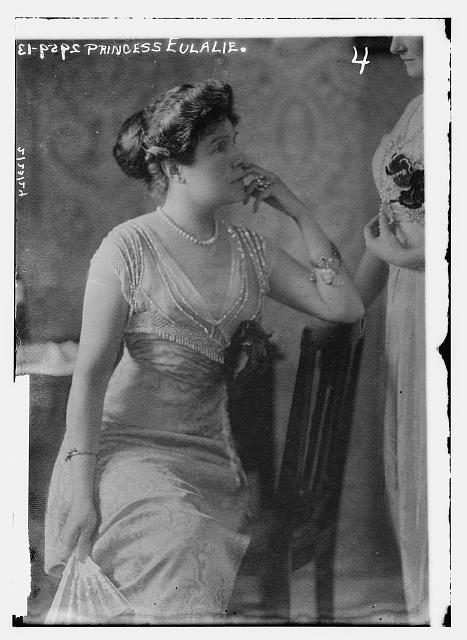 |
| Library of Congress |
In 1893, the blue-eyed Infanta, who was barely 5 feet tall and weighed less than 100 pounds, arrived in New York, en route to Chicago to attend the World's Fair. Eulalia's "glittering gowns dazzled local citizens." She "snubbed social leaders to eat sausages on the midway at the fair." She was expected to attend mass at a cathedral but went instead to a Roman Catholic church in a poor parish.
But Infanta Eulalia "chose her friends by the size of their bankroll."
Eulalia failed to win Papal permission for a divorce, although she remained separated from her husband. She moved to Paris and "began the practice of presenting American millionaires to noble families." Business leaders and their wives would be introduced to "Eulalia's relatives with every royal house of Europe," and, in return, Eulalia would "receive a gift of an automobile or the loan of a yacht."
Infanta Eulalia was the author of several books, where she "related her experiences, observations, and opinions." Her first book, "Au Fil de a Vie," "nearly upset negotiations between France and Spain over Morocco in 1911.
Her nephew, King Alfonso XIII of Spain, was so furious with her that he sent her a telegram "forbidding the publication of the book." Alfonso's order and Eulalia's reply were both published on page one of the New York Times.
The book sold "like hot cakes" in France, and Alfonso threatened to end all negotiations with France.
In a telegram to her nephew, 23, Eulalia wrote: "I am astonished that anyone should judge a book before knowing what it is. Such a thing is only possible in Spain. Never have loved court life, I take this opportunity to bid you goodbye, for, after such a proceeding, which is worthy of the Inquisition, I consider myself free to live in private life as seems good to me."
The root of this particular scandal was Eulalia's defense of divorce. She also wrote of improving conditions for servants and working-class men and women. and she "pleaded for the equality of the sexes."
Eulalia showed sympathy for the poor, but this was balanced with a "let-them-eat-cake" attitude."
Eulalia, a very opinionated woman, often visited her two sons, Alfonso, and Luis Fernando, at Eton, although she was never invited to Windsor Castle or Buckingham Palace. Her final book was "Memories of a Spanish Princess," which was published in 1937.
She wrote: "We who have seen so many of our traditions crumble in the dust find our one solace in the knowledge that a new world is about to evolve." She "banked on Generalissimo Francisco Franco to bring about that new world."
Eulalia once owned $5,000,000 in jewels, which she had inherited from her mother. In 1935, the "jewel box went astray in Madrid."
After her income was cut off after Alfonso XIII's abdication in 1931, Eulalia "moved into modest quarters in Paris."
Infanta Eulalia is survived by her son, Infante Don Alfonso, Duke of Galliera, his wife, Beatrice, and their children and grandchildren. Her younger son, Luis Fernando, died in 1945.
Bernhard has lunch with the Trumans
March 9, 1950
Prince Bernhard of the Netherlands, in Washington, D.C., on an unofficial visit, had lunch today at Blair House with President and Mrs. Truman, according to the Chicago Daily Tribune. Bernhard is the husband of Queen Juliana of the Netheralands, who did not accompany him on this visit to the United States.
Prince Bernhard of the Netherlands, in Washington, D.C., on an unofficial visit, had lunch today at Blair House with President and Mrs. Truman, according to the Chicago Daily Tribune. Bernhard is the husband of Queen Juliana of the Netheralands, who did not accompany him on this visit to the United States.
Otto has tea with Roosevelt
March 8, 1940
Archduke Otto of Austria was the "guest of honor today at the White House at a tea given by the President and Mrs. Roosevelt," the New York Times reports.
Otto was accompanied by his brother, Archduke Felix. There were no other guests. Earlier today, the two brothers received a "rising greeting from the Senate "where they went to observe deliberations from the members' private gallery." Senator Barkely called attention to the archdukes' preseence, and suggested that "as a courtesy we rise and greet them." The Senators stood for about a minute, and Otto and Felix "bowed in acknowledgment."
Archduke Otto of Austria was the "guest of honor today at the White House at a tea given by the President and Mrs. Roosevelt," the New York Times reports.
Otto was accompanied by his brother, Archduke Felix. There were no other guests. Earlier today, the two brothers received a "rising greeting from the Senate "where they went to observe deliberations from the members' private gallery." Senator Barkely called attention to the archdukes' preseence, and suggested that "as a courtesy we rise and greet them." The Senators stood for about a minute, and Otto and Felix "bowed in acknowledgment."
Ileana still wearing ring
March 8, 1930
Queen Marie of Roumania and her youngest daughter, Princess Ileana, were on board the riverboat, Mayflower, and left Aswan for Wadi Halfa. The Princess was "still wearing her engagement ring," despite the official announcement on Thursday that her engagement with Count Alexander von Hochberg, had been broken," reported the AP today.
Queen Marie of Roumania and her youngest daughter, Princess Ileana, were on board the riverboat, Mayflower, and left Aswan for Wadi Halfa. The Princess was "still wearing her engagement ring," despite the official announcement on Thursday that her engagement with Count Alexander von Hochberg, had been broken," reported the AP today.
Subscribe to:
Posts (Atom)